Hello Everyone,
While listening to the Fisheries Museum of the Atlantic’s Maud R.M., complete with the put-put-put of an authentic make-and-break engine, I’m reminded that our shoreline waterways were once the main highway for coastal residents.
Whether people travelled by sail power or were propelled by oars or eventually by marine engines, the little boats of the coast linked island dwellers with the mainland. Trips to shore were carefully planned, incorporating trips to stores, visits with friends and relatives and rare appointments with doctors.
When make-and-break engines were first developed, at the turn of the 20th century, they gave an element of security to isolated communities. People were no longer dependent upon the weather; if it was "flat calm" they were still able to get to shore. More importantly, unless there was a vicious storm, they were able to go to shore to get doctors and members of the clergy, if there was an emergency at home.
The simple mechanics of the first marine engines made them user-friendly for those who had no previous experience with machinery.
The make and break experience is still available, for those who visit the Fisheries Museum of the Atlantic, in Lunenburg, Nova Scotia. The inshore boat replica, Maud R. M., putters around Lunenburg harbour at least once a week - and several lucky visitors to the Museum are able to take part in the tour!
Wishing you Smooth Sailing,
Heather
Showing posts with label tourism. Show all posts
Showing posts with label tourism. Show all posts
Monday, August 18, 2008


Monday, July 14, 2008
Set Sail for Lunenburg!
Hello Everyone,
One of the most wonderful aspects of a Museum is that it can be the focal point in the sharing of history between those who have roots in an area and those who visit. Although this sharing of history happens every day, special events make the exchange even more meaningful.
The Fisheries Museum of the Atlantic, in Lunenburg, Nova Scotia, is nearing its anniversary. Each year, on 23 July, we celebrate the history of the Atlantic fishery, especially as it pertains to the Canadian coast.
This year, on 23 July, we’re celebrating both the anniversary of the Museum and the 70th anniversary year of the schooner Theresa E. Connor. Theresa E. Connor is the flagship of the Museum and we are tremendously excited to be celebrating 70 years of her history!
Theresa E. Connor is the oldest saltbank schooner in Canada. In almost 30 years of fishing, the vessel never lost a crew member. During the course of her career, the vessel fished both fresh and salt fishing. This meant that sometimes the catch was preserved on ice (fresh) and sometimes it was preserved in salt (salt fishing).
If you’re planning to head our way on Wednesday 23 July, you’ll be highly entertained! Special events, musical entertainment and historical re-enactments are part of the celebrations. Theresa E. Connor will be open, free-of-charge to the public on that day! Retired fishermen and heritage interpreters will make the vessel come to life, with demonstrations and talks.
Wishing you Smooth Sailing,
Heather
Friday, June 20, 2008

Hello Everyone,
The Fisheries Museum of the Atlantic is heavily involved with the Toronto Nautical Festival, running this weekend (Friday, 20 June to Sunday). In addition to a fine display booth highlighting both the Museum and the town of Lunenburg, our boat builder is constructing a Lunenburg dory at the Festival.
The Province of Nova Scotia has also sent Lunenburg's fine ambassador, Bluenose II, to be the flagship of the event. The Province issued the following press release:
Nova Scotia's sailing ambassador, the world famous schoonerBluenose II, is sailing into Toronto, bringing with it the sights and sounds of Canada's seacoast province. The visit is part of the 2008 Nautical Festival at the Toronto Harbourfront Thursday, June 19 to Sunday, June 22. "We are thrilled to have Bluenose II at the Toronto Nautical Festival," said Bill Dooks, Minister of Tourism, Culture and Heritage. "While she was born in Nova Scotia, Bluenose II is a symbol of endurance and achievement for all Canadians and remains a wonderful ambassador for our province."
The event will feature a Nova Scotian pavilion, including a wide range of industry professionals demonstrating new products, sharing experiences and offering samples from Canada's seacoast province. It will also give the public an opportunity to stroll the deck of Bluenose II.
Popular entertainers, such as the Barra MacNeils, will perform at the festival, immersing Toronto residents in Nova Scotia's rich and lively music. Information about Nova Scotia as a travel destination will be featured at the Nautical Festival. Included will be an outline of air travel options available to those interested in visiting Nova Scotia from Toronto's Pearson International and City Centre airports.
The original Bluenose was launched from a shipyard in Lunenburg on March 26, 1921. Because of wins in the races of Grand Banks schooners between Canada and the U.S., the Bluenose became known as Queen of the North Atlantic. In 1963, the ship's replica, Bluenose II, was launched from the same shipyard, also built by many of the same men who worked on the original Bluenose.
=====
If you're in Toronto this weekend, drop in an visit with our staff from the Fisheries Museum of the Atlantic!
Wishing you Smooth Sailing,
Heather
Thursday, June 19, 2008
Looks can be Deceiving

Hello Everyone,
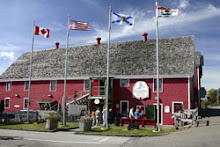
Brightly painted red buildings on the waterfront in Lunenburg, Nova Scotia are eye-catching, gorgeous and almost a dime-a-dozen. The Fisheries Museum of the Atlantic stands out from the crowd, with a large parking lot and attractive flags at the entrance, but for those who approach by land and not sea, looks can be deceiving.
Many first-time visitors to the Museum have no idea how large the site is, with several inter-connected buildings, an authentic fishing schooner, a retired fishing trawler (both open to the public), a theatre, exhibits and an aquarium.
The boat shop, at the far end of the property, is often a hive of activity. The boat builder constructs dories, as well as special projects of various types of small boats.
The Whaling and Whales exhibit is tremendously popular, especially with school groups. A traditional, albeit Norwegian, whale arch frames the entrance. The arch is composed of the jaw bones of a fin whale. Laughter and excitement bubble to the fore, when students measure out the length of fin and blue whales, on the wharf.
Described as friendly and fascinating, the Fisheries Museum of the Atlantic has many exhibits and activities for visitors. Rather than being "too small", the Museum offers delights that have enraptured visitors for many hours, as well as days!
Wishing you Smooth Sailing,
Heather
Thursday, March 20, 2008
Upcoming Season at Fisheries Museum
No matter what the season, one of the most delightful ways to spend a few hours, or an entire day, is a visit to Lunenburg’s Fisheries Museum of the Atlantic. Several major exhibits are open year-round, Monday - Friday (holidays excepted). In the winter and early spring, Wednesday mornings are Movie Mornings, with showings from the Museum’s heritage collection, at 10:00 a.m.
Full season programming begins on May 17, with visitors encouraged to explore many aspects of Nova Scotia’s maritime heritage. Exciting activities and a wonderful salt and fresh water aquarium engage people of all ages. Exhibit topics include rum running, losses at sea, the famous Bluenose and the history of fishing on the Banks.
2008 marks the 70th anniversary of the launch of Canada’s oldest saltbank schooner, Theresa E. Connor. The flagship of the Fisheries Museum of the Atlantic, Theresa E. Connor is a tribute to all schooners that plied their trade on the Banks. Stepping aboard the vessel is like going back in time, where you can see a schooner ready for work and talk with men who fished on the Banks.
Cape Sable, a steel-hulled side trawler, is also open to the public, with retired fishermen sharing stories of their times at sea.
Local maritime heritage is celebrated in many ways, at the Museum. Special events are scheduled throughout the season, but every day is a special day, with thrilling discoveries and activities. Visitors enjoy the ultimate waterfront experience, at the Fisheries Museum of the Atlantic.
Thursday, February 7, 2008
Dory Fishing
Hello Everyone,
The Fisheries Museum of the Atlantic is perched on the edge of Lunenburg’s front harbour. In fact, we’re actually out over the edge, between land and sea, with some of our buildings and the wharves. Our largest vessels, the schooner Theresa E. Connor and the trawler Cape Sable, float alongside, at dock.
Lunenburg really does offer the best of both worlds: history is alive within this UNESCO World Heritage Site and modern technology thrives, with businesses such as HB Studios and Composites Atlantic.
Given that this is not the land where time stood still, it is heartening to look out at the harbour and see authentic Lunenburg dories being rowed. The young women and men who practice their rowing skills in the dories are doing it for many reasons, including the International Dory Races, which are held each year.
The Lunenburg Dory is as essential to the story of the schooner fishery as the larger vessels themselves. Dory fishing changed the landscape of Lunenburg and all coastal communities that were involved in the schooner fishery.
Although there is scholarly debate in terms of when dory fishing began, the date is usually set in the 1850s. As late as the 1830s-1870s, fishermen fished from the decks of the schooners, each using one or two long fishing lines. This began to change on this coast in the 1850s, when enterprising American fishermen began to go out in dories, from the mother schooner. This was called "single dory fishing", as each dory contained only one fisherman. They still fished with one to three lines (one would be tied to a tholepin).
In the 1860s, double dory (larger dories with two men) fishing changed the schooner fishery forever. Instead of a few lines, with one or two hooks each, fishermen now set long lines of trawl, with thousands of hooks per dory. The resultant economic boom in the fisheries meant that communities enjoyed financial rewards far beyond anything that had gone before that time.
In Lunenburg, double dory fishing began in 1873, with Captain Benjamin Anderson at the helm of the schooner Dielytris. He took four dories and a crew of 13. Four other vessels were similarly equipped and went with him to the Western Banks, near Sable Island. The companion schooners went home, quickly disheartened with the experiment. Captain Anderson stayed on and had a very successful fishing trip.
Dory fishing caused such a dramatic change in the industry that Lunenburg went from a fishing community with 15 schooners, in the mid-1800s, to a thriving port that was home to more than 100 schooners at the turn of the 20th century.
Wishing you Smooth Sailing,
Heather
Wednesday, January 30, 2008
Fisheries Museum of the Atlantic in Lunenburg, Nova Scotia

Hello Everyone,
When you visit Lunenburg and the Fisheries Museum of the Atlantic, you can be assured of an experience that focuses on excellence and authenticity.
Our streetscapes are filled with structures that are proudly maintained and painted in almost every colour of the rainbow. "Red" is the colour of choice along the waterfront and the Museum buildings are gleaming examples of that selection. The bright buildings beckon with the promise of activity, fun and a look into the seafaring history of Atlantic Canada.
The Fisheries Museum of the Atlantic sits on the edge of the waterfront, complete with the vessels Theresa E. Connor and Cape Sable. During the summer we have full programming, which includes excursions in the harbour with one of our smaller vessels, the Maud R.M. The sounds of the make-and-break engine aboard the Maud R.M. fill the air, taking us back to the turn of the 20th century. In those days, the put-put-put sound was familiar all along the coast, when the water ways were the highways for those who lived next to the ocean.
Whether you come by land or by sea, we look forward to sharing our stories and experiences with you.
Wishing you Smooth Sailing,
Heather
Wednesday, January 16, 2008
Lunenburg "hung on a fish hook"
Hello Everyone,
There’s an old saying that Lunenburg "hung on a fish hook". It means that the future and good fortune of the town relied completely on the success of the fisheries.
For most of our 255 year history, this has been accurate. The first generation of Lunenburgers consisted mostly of farmers. By the time of the second generation, we were well established as a place for shipbuilding and for fishing.
Like many coastal communities in Atlantic Canada, we starting fishing close to shore, then moved out towards the various fishing banks of the North Atlantic.
Canada’s oldest saltbank schooner, Theresa E. Connor, is the flagship of the Fisheries Museum of the Atlantic. Launched in December 1938, the schooner was born into a time of danger on the Banks. The Theresa E. Connor did not start fishing until the first months of 1939; in less than a year, the world was at war, again.
Fishing schooners were in danger from enemy U-boats as well as from convoys and large shipping vessels. Torpedoed and cut down, men and vessels were lost at sea.
Theresa E. Connor survived the war years. Equipped with an engine, as well as sails, the men fished from little dories and salted their catch in the hold of the vessel. Eventually the Theresa E. Connor went fresh fishing, as well. This meant that the men still fished from the dories, but the fishing trips were shorter, as the catch was put on ice in the hold. Since the fish were not salted, they were "fresh".
The spirit of adventure has not dimmed along the Atlantic coast. A visit to the Fisheries Museum of the Atlantic guarantees memories of the best of Nova Scotia!
Wishing you Smooth Sailing,
Heather
Tuesday, January 15, 2008
Where Down is Never Up
Hello Everyone,
Planning a visit to Lunenburg, Nova Scotia? You’ll find that the folks are generally very friendly, the food is incredible, the tours of the town are fun and the museums are fabulous. We’re also one of Atlantic Canada’s leading cultural communities, with 19 art galleries. Old Town Lunenburg maintains its charm as a UNESCO World Heritage Site. This all takes place within a community of 2,300 people!
Superstitions have had a way of creeping into the lives of Lunenburgers for as long as memory can recall. Although some of the habits seem comical, it’s important to realize that the superstitions originated as a way for people to feel that they had control over uncontrollable aspects of their lives. In the age of sail, when loved ones were away from home for months at a time, families would do anything that they could, to protect those who were on the North Atlantic.
In my childhood, I watched my mother carefully follow the same ritual, each time she baked bread. The hot loaves would be carefully tipped, partly to one side, and eased out of their pans. They were then put upright, on cooling racks.
This didn’t seem odd to me. It was only after I began working at the Fisheries Museum of the Atlantic that I discovered that it is an age-old tradition. Whenever there were friends or family at sea, the women would never turn a pan upside down ... nor would they turn a loaf of bread upside down. The fear was that if they did, the schooner on which their loved ones were sailing would be caught in a storm and would capsize.
As I said, this was a way of dealing with daily fears. A strong belief in the superstitions gave a sense of control in lives that were forever fraught with uncontrollable elements of nature.
Wishing you Smooth Sailing,
Heather
Subscribe to:
Posts (Atom)