Hello Everyone,
While listening to the Fisheries Museum of the Atlantic’s Maud R.M., complete with the put-put-put of an authentic make-and-break engine, I’m reminded that our shoreline waterways were once the main highway for coastal residents.
Whether people travelled by sail power or were propelled by oars or eventually by marine engines, the little boats of the coast linked island dwellers with the mainland. Trips to shore were carefully planned, incorporating trips to stores, visits with friends and relatives and rare appointments with doctors.
When make-and-break engines were first developed, at the turn of the 20th century, they gave an element of security to isolated communities. People were no longer dependent upon the weather; if it was "flat calm" they were still able to get to shore. More importantly, unless there was a vicious storm, they were able to go to shore to get doctors and members of the clergy, if there was an emergency at home.
The simple mechanics of the first marine engines made them user-friendly for those who had no previous experience with machinery.
The make and break experience is still available, for those who visit the Fisheries Museum of the Atlantic, in Lunenburg, Nova Scotia. The inshore boat replica, Maud R. M., putters around Lunenburg harbour at least once a week - and several lucky visitors to the Museum are able to take part in the tour!
Wishing you Smooth Sailing,
Heather
Showing posts with label lunenburg. Show all posts
Showing posts with label lunenburg. Show all posts
Monday, August 18, 2008


Monday, July 28, 2008
Ship to Shore ...
Hello Everyone,
This morning, Lunenburg’s front harbour is like a pond of burnished silver, reflecting the colours of the sky, paused with an pregnant hush. Will it rain? Will it clear? We don’t know.
It is an easy thing to stand on land and look out to the ocean, wondering what the weather conditions might bring. It is an entirely different matter to be on the ocean, especially aboard a fishing vessel, and be at the mercy of the whims of nature.
Now-a-days, with computers and a multitude of ship-to-shore communications, sudden storms rarely arrive without some form of advance warning. Mariners no longer have to base their survival on the rhyming ditties of old, including:
Red sky in the morning,
Sailors take warning.
Red sky at night,
Sailor’s delight.
Sadly, the change in communication has taken place only within the span of a lifetime. The turning point for Nova Scotian schooners came with the August Gales of 1926 and 1927. Although the technology had been available before that date, fishing schooners were not equipped with receivers until after the horrific loss of life in the Gales.
Although the hurricanes hit along the shore and caused wide-spread destruction, the Lunenburg fleet was hit particularly hard. In those two years, 138 fishermen aboard six Lunenburg schooners were lost. One of the keenest felt aspects of the tragedy is that those on land knew of the approaching storms, based on weather reports. The men aboard the schooners had no such luxury and unwittingly faced a dark future.
After the 1927 Gale, the Province of Nova Scotia made arrangements to have weather signals sent via radio, from Cape Breton. The owners of the schooners were instructed to install radio receivers aboard their vessels. Those two simple acts, previously avoided because of the expense, undoubtedly saved countless lives.
Wishing you Smooth Sailing,
Heather
Monday, July 14, 2008
Set Sail for Lunenburg!
Hello Everyone,
One of the most wonderful aspects of a Museum is that it can be the focal point in the sharing of history between those who have roots in an area and those who visit. Although this sharing of history happens every day, special events make the exchange even more meaningful.
The Fisheries Museum of the Atlantic, in Lunenburg, Nova Scotia, is nearing its anniversary. Each year, on 23 July, we celebrate the history of the Atlantic fishery, especially as it pertains to the Canadian coast.
This year, on 23 July, we’re celebrating both the anniversary of the Museum and the 70th anniversary year of the schooner Theresa E. Connor. Theresa E. Connor is the flagship of the Museum and we are tremendously excited to be celebrating 70 years of her history!
Theresa E. Connor is the oldest saltbank schooner in Canada. In almost 30 years of fishing, the vessel never lost a crew member. During the course of her career, the vessel fished both fresh and salt fishing. This meant that sometimes the catch was preserved on ice (fresh) and sometimes it was preserved in salt (salt fishing).
If you’re planning to head our way on Wednesday 23 July, you’ll be highly entertained! Special events, musical entertainment and historical re-enactments are part of the celebrations. Theresa E. Connor will be open, free-of-charge to the public on that day! Retired fishermen and heritage interpreters will make the vessel come to life, with demonstrations and talks.
Wishing you Smooth Sailing,
Heather
Monday, June 30, 2008
Blowing in the Wind
Hello Everyone,
As noted several times, the Fisheries Museum of the Atlantic is perched on the edge of Lunenburg’s front harbour.
Our front harbour has been witness to a great deal of history. The month of June always puts me in mind of Lunenburg’s first settlers. The Foreign Protestants who first populated our town came in two small waves of settlement, arriving on June 8 and June 17.
The weather played havoc with the plans and good intentions of the British military, who organized the settlement.
The initial flotilla of 14 transport ships that brought the first Lunenburgers to port, left Halifax at the end of May. The trip was expected to take only a day or two, but provisions for one week were packed, to ensure victuals for the voyage and the first few days in their new home.
Unfortunately, crew members eager to embark on their voyage put the provisions deep in the holds of the vessels, along with the settler’s baggage. Food and water were inaccessible. While the vessels waited out a period of "flat calm breeze" (i.e., no wind), word was sent to Halifax that fresh provisions were required. Settlers and crew waited a week before they were able to get a good sailing wind. Very early on the morning of June 7th, they left a cove near Halifax and ventured forth.
The early hours of June 8 saw the first Foreign Protestants grace the surface of Lunenburg’s front harbour. The second wave arrived on June 17, after a mere two days at sea.
From that point onward, the fine settlers put down roots and established a world-famous seaport - although most of the first generation Foreign Protestants were farmers!
Wishing you Smooth Sailing,
Heather
Thursday, June 19, 2008
Looks can be Deceiving

Hello Everyone,
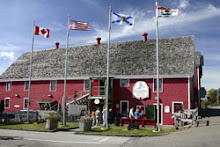
Brightly painted red buildings on the waterfront in Lunenburg, Nova Scotia are eye-catching, gorgeous and almost a dime-a-dozen. The Fisheries Museum of the Atlantic stands out from the crowd, with a large parking lot and attractive flags at the entrance, but for those who approach by land and not sea, looks can be deceiving.
Many first-time visitors to the Museum have no idea how large the site is, with several inter-connected buildings, an authentic fishing schooner, a retired fishing trawler (both open to the public), a theatre, exhibits and an aquarium.
The boat shop, at the far end of the property, is often a hive of activity. The boat builder constructs dories, as well as special projects of various types of small boats.
The Whaling and Whales exhibit is tremendously popular, especially with school groups. A traditional, albeit Norwegian, whale arch frames the entrance. The arch is composed of the jaw bones of a fin whale. Laughter and excitement bubble to the fore, when students measure out the length of fin and blue whales, on the wharf.
Described as friendly and fascinating, the Fisheries Museum of the Atlantic has many exhibits and activities for visitors. Rather than being "too small", the Museum offers delights that have enraptured visitors for many hours, as well as days!
Wishing you Smooth Sailing,
Heather
Wednesday, June 18, 2008
Ride the Lobster!
Hello Everyone,
The Fisheries Museum of the Atlantic is open for the summer season, with more activities and delights than you would ordinarily imagine.
One of the special events that came our way is the Ride the Lobster ( www.ridethelobster.com ) unicycle race! It is an international race, with 36 teams racing 800 km along the length of Nova Scotia (apparently we’re the crustacean-shaped province).
The cyclists came rushing through Lunenburg, yesterday, and the Fisheries Museum of the Atlantic was one of the official check-in stations. It was simply amazing to see the riders balanced atop large unicycles, cycling at speeds of upwards of 25 km per hour. On the open highway, the more experienced racers are able to go even faster.
One of the special treats that we had on-site for the afternoon was a trio from the Lunenburg County Fiddlers. They blended into the festive spirit of the day, with their lively Down East music. One of the unicycle team members, a fellow from British Columbia, was ecstatic with the chance to listen and to perform with the group. A trained violinist, he has been picking up various forms of violin (or fiddle) music - and his dulcet tones and remarkable ability enriched the musical experience for everyone.
Ride the Lobster continues through the rest of the week, moving into Cape Breton for the grand finale.
Wishing you Smooth Sailing,
Heather
Thursday, March 20, 2008
Upcoming Season at Fisheries Museum
No matter what the season, one of the most delightful ways to spend a few hours, or an entire day, is a visit to Lunenburg’s Fisheries Museum of the Atlantic. Several major exhibits are open year-round, Monday - Friday (holidays excepted). In the winter and early spring, Wednesday mornings are Movie Mornings, with showings from the Museum’s heritage collection, at 10:00 a.m.
Full season programming begins on May 17, with visitors encouraged to explore many aspects of Nova Scotia’s maritime heritage. Exciting activities and a wonderful salt and fresh water aquarium engage people of all ages. Exhibit topics include rum running, losses at sea, the famous Bluenose and the history of fishing on the Banks.
2008 marks the 70th anniversary of the launch of Canada’s oldest saltbank schooner, Theresa E. Connor. The flagship of the Fisheries Museum of the Atlantic, Theresa E. Connor is a tribute to all schooners that plied their trade on the Banks. Stepping aboard the vessel is like going back in time, where you can see a schooner ready for work and talk with men who fished on the Banks.
Cape Sable, a steel-hulled side trawler, is also open to the public, with retired fishermen sharing stories of their times at sea.
Local maritime heritage is celebrated in many ways, at the Museum. Special events are scheduled throughout the season, but every day is a special day, with thrilling discoveries and activities. Visitors enjoy the ultimate waterfront experience, at the Fisheries Museum of the Atlantic.
Wednesday, March 5, 2008
The Courage To Do The Impossible ...
Marlon Brando in "Mutiny on the Bounty". Russell Crowe in "Master and Commander". Captain Angus Walters aboard the famous Bluenose.
What do these three men have in common? The connection is found through their vessels; the replicas of the HMS Bounty and the HMS Rose (later HMS Surprise) and the original Bluenose were all built at the Smith and Rhuland Shipyard, in Lunenburg Nova Scotia.
The replica of HMS Bounty was launched in 1960, to the cheers of thousands of Lunenburgers and visitors to the community. It sparked the movement to build a replica of our own Bluenose, and in 1963, Bluenose II slid down the ways at the Smith and Rhuland Shipyard.
In 1970, the replica of HMS Rose was constructed at the same Yard. Marine history buffs were delighted to see another part of nautical history come to life under the skilled hands of Lunenburg craftsmen. In 2003, HMS Rose was immortalized in the release of "Master and Commander", as the vessel HMS Surprise. In honour of that role, the name of the ship was officially changed to HMS Surprise.
The Smith and Rhuland Shipyard was one of the best-known shipyards in Nova Scotia. Located on the Lunenburg waterfront, the Yard produced more than one hundred fine ships. The Shipyard was the creation of Richard Smith and George Rhuland and was established in 1900. In their first year, they built two vessels: Palatia and Quisetta.
From 1900 until the mid-1970s, many vessel designs went from half-models to full-sized craft. Fishing vessels, like the Fisheries Museum of the Atlantic’s Theresa E. Connor were built there, as were larger "ocean-going" ships. Vessels that were used for pleasure craft and in serious work went hand-in-glove with other, adventurous ships ~ like rum runners!
The mainstay of the Smith and Rhuland Shipyard, though, remained in the fishery. The fine vessels, the shipwrights that crafted them and the men who sailed them can all be brought together under the same tagline used in the movie "Master and Commander": The Courage To Do The Impossible Lies in the Hearts of Men.
For every fisherman who has gone to sea and for their brave families on shore, the Fisheries Museum of the Atlantic celebrates their dreams and honours their sacrifices.
Wishing you Smooth Sailing,
Heather
Monday, March 3, 2008
Lunenburg on the Money!

Hello Everyone,
We’ve always said that the smell of fish, when being made into various products at a fish processing plant, is the "smell of money". I’m sure that Lunenburg is not alone in that regard. Fish processing, whether it was in the days of salt fish or in modern plants, has been the economic backbone of coastal communities.
The Museum schooner Theresa E. Connor played a successful part in the economy of Nova Scotia, from 1938 until 1966. The vessel was originally owned by the Halifax-based National Fish Company.
However, Theresa E. Connor has an added connection with the Canadian economy. The Canadian one hundred dollar bill, issued from May 1976 until December 1990, had a picture of three vessels on the Lunenburg waterfront. It was part of the Bank of Canada’s "Scenes of Canada Series". The vessels were, from left to right, Lilla B. Boutilier, E. P. Theriault and Theresa E. Connor. The schooner Lilla B. Boutilier was the sister ship to Theresa E. Connor. The original photograph, from which the engraving was copied, dates to early 1939.
On 3 December 1990, the Birds of Canada Series one hundred dollar bill was first issued. The front of the bank note remained the same, with Prime Minister Robert Borden. The reverse showed the Canada goose.
Wishing you Smooth Sailing,
Heather
Friday, February 15, 2008
Canada's Oldest Saltbank Schooner

Hello Everyone,
The flagship of the Fisheries Museum of the Atlantic is the retired fishing schooner Theresa E. Connor. Launched on 14 December 1938, from the Smith and Rhuland Shipyard in Lunenburg, Nova Scotia, the vessel fished until the mid-1960s. In 1967, as Lunenburg’s Centennial of Confederation project, Theresa E. Connor was unveiled as the Lunenburg Fisheries Museum.
The schooner is important because it is representative of thousands of two-masted fishing schooners that plied their trade all along the Atlantic coast of Canada and the United States. In turn, crew life aboard Theresa E. Connor also speaks of the lives of hundreds of thousands of fishermen.
As a saltbank schooner, Theresa E. Connor fished on the fishing banks near Newfoundland and Labrador, as well as those nearer Nova Scotia. The men fished from dories and brought their catch back to the mother schooner. The fish, mostly cod, were cleaned and then preserved in salt, in the hold of the vessel.
Theresa E. Connor was launched into a time that included steel trawlers. The last of the schooners fished virtually side-by-side with side trawlers that hauled their catch aboard their vessels with huge nets.
The fishing history of Theresa E. Connor ended on a bitter-sweet note. In May 1963, Captain Harry Oxner prepared the schooner for one final trip to the Banks. With a few Lunenburg-area fishermen, he set sail for Fortune Bay, Newfoundland, to get the remainder of his crew.
Unfortunately, the steady march of progress and technology made it impossible for him to get additional crew members for the last salt fishing trip. No one was willing to undertake the danger and hard work of dory fishing, when they had the chance to go on trawlers. Although the work was still hard and dangerous, they did not risk the danger of being lost in a dory.
The schooner spent the remainder of 1963 fishing with cod traps, in the Labrador fishery. Theresa E. Connor continued to fish, in a reduced capacity, for Zwicker and Company (Lunenburg) until 1966. The vessel was then sold to the Lunenburg Marine Museum Society.
Since then, hundreds of thousands of visitors have been welcomed aboard the schooner. The retired fishing captains who now work aboard the vessel share their experiences with people from around the world, keeping the memories alive for new generations.
Wishing you Smooth Sailing,
Heather
Friday, February 8, 2008
March Break Ahead!

Hello Everyone,
Glimpses of sunshine and a renewed freshness in the air give hope of springtime, even when we are going from pillar to post between snowstorms.
The Fisheries Museum of the Atlantic, in Lunenburg, Nova Scotia, is making plans to celebrate during next month’s spring break for school students. The March Break takes place between March 10 - 14, in Nova Scotia.
Special events will be held each day, at the Museum. Highlights include building your very own Styrofoam tugboat with the help of the South Shore Ship Modeller’s Guild. This enthusiastic group of volunteers will be at the Museum on Friday, March 14, with the programme running at 10 a.m. and 2 p.m.
Other activities will include films, crafts and stories. Our aquarium, as well as other exhibits, will be open to the public, ensuring that there is something fun for everyone!
Please check our website, http://fisheries.museum.gov.ns.ca for updates for the March Break Special Events. Pre-booking for registration will ensure that you have a space. Registration can be done by email, smithls@gov.ns.ca or by calling the Museum at 902-634-4794.
Wishing you Smooth Sailing,
Heather
Thursday, February 7, 2008
Dory Fishing
Hello Everyone,
The Fisheries Museum of the Atlantic is perched on the edge of Lunenburg’s front harbour. In fact, we’re actually out over the edge, between land and sea, with some of our buildings and the wharves. Our largest vessels, the schooner Theresa E. Connor and the trawler Cape Sable, float alongside, at dock.
Lunenburg really does offer the best of both worlds: history is alive within this UNESCO World Heritage Site and modern technology thrives, with businesses such as HB Studios and Composites Atlantic.
Given that this is not the land where time stood still, it is heartening to look out at the harbour and see authentic Lunenburg dories being rowed. The young women and men who practice their rowing skills in the dories are doing it for many reasons, including the International Dory Races, which are held each year.
The Lunenburg Dory is as essential to the story of the schooner fishery as the larger vessels themselves. Dory fishing changed the landscape of Lunenburg and all coastal communities that were involved in the schooner fishery.
Although there is scholarly debate in terms of when dory fishing began, the date is usually set in the 1850s. As late as the 1830s-1870s, fishermen fished from the decks of the schooners, each using one or two long fishing lines. This began to change on this coast in the 1850s, when enterprising American fishermen began to go out in dories, from the mother schooner. This was called "single dory fishing", as each dory contained only one fisherman. They still fished with one to three lines (one would be tied to a tholepin).
In the 1860s, double dory (larger dories with two men) fishing changed the schooner fishery forever. Instead of a few lines, with one or two hooks each, fishermen now set long lines of trawl, with thousands of hooks per dory. The resultant economic boom in the fisheries meant that communities enjoyed financial rewards far beyond anything that had gone before that time.
In Lunenburg, double dory fishing began in 1873, with Captain Benjamin Anderson at the helm of the schooner Dielytris. He took four dories and a crew of 13. Four other vessels were similarly equipped and went with him to the Western Banks, near Sable Island. The companion schooners went home, quickly disheartened with the experiment. Captain Anderson stayed on and had a very successful fishing trip.
Dory fishing caused such a dramatic change in the industry that Lunenburg went from a fishing community with 15 schooners, in the mid-1800s, to a thriving port that was home to more than 100 schooners at the turn of the 20th century.
Wishing you Smooth Sailing,
Heather
Wednesday, February 6, 2008
Bluenose II
Hello Everyone,
When I look out my office window, at the Fisheries Museum of the Atlantic, in Lunenburg, Nova Scotia, part of my immediate view is of the ratlines of the schooner Bluenose II. A closer look reveals the masts and deck of this famous sailing ambassador of Nova Scotia.
Bluenose II is owned by the Province of Nova Scotia and is operated by the Board of Directors of the Lunenburg Marine Museum Society. This same organization operates the Fisheries Museum of the Atlantic for the Nova Scotia Museum.
Bluenose II is history renewed, revitalized and alive. Built at the Smith and Rhuland Shipyard, here in Lunenburg, in 1963, Bluenose II is a tribute to the original Bluenose, built at the same Yard in 1921.
The original vessel won international acclaim as the undefeated champion of the North Atlantic. Bluenose raced against the best of the American fishing schooners, in the International Fishermen’s Series, from 1921 to the last race in 1938, winning each Series. The schooner was a fishing vessel, a racer and an ambassador, travelling as far as England during the King’s Jubilee in 1935.
Bluenose II has made her own splash in history and continues to bring the experience of going to sea alive for both crew and visitors. Each year, Bluenose II travels to a variety of ports and welcomes thousands of visitors aboard. Short cruises are available, when weather permits.
Nothing compares to the sound of the sails filled with a breeze, on the great Atlantic, or even in the waters of the St. Lawrence River and the Great Lakes.
In 2008, the ports of call include Gaspé, Montréal, Toronto, Quebec City, Gloucester and, for the first time, Sainte-Pierre.
The website for Bluenose II contains up-to-date information about the comings and goings of the schooner. http://museum.gov.ns.ca/bluenose/index.htm
Wishing you Smooth Sailing,
Heather
Tuesday, February 5, 2008
Under the Seas!
 Hello Everyone,
The aquarium at the Fisheries Museum of the Atlantic, in Lunenburg, Nova Scotia, gives visitors a chance to get up close and personal with a variety of species that are important to the east coast fisheries.
The centrepiece of the display is a large vista tank, which holds 22,706 litres (6000 gallons) of water. It is home to a variety of salt water species, all living in harmony with each other. It’s not unusual for visitors to see a haddock or cod come to the surface, to take a look around! If you look closely, you are apt to see a large lobster nestled into the rocks, at the bottom of the tank.
Fishermen sometimes help us with the most interesting examples of lobsters. Over the years, blue lobsters, white albino lobsters and those that are half green and half red have resided with us, all courtesy of enterprising fishermen who decide to donate their freshly caught crustaceans to the Museum.
The aquarium is one of the largest in Atlantic Canada, with eleven salt water and three fresh water tanks, operating with three enclosed water systems.
Popular with all ages, the displays of fish and shellfish are augmented with colourful, descriptive panels of text and images. Museum staff are stationed in the area, especially during the full open season from May to October, and provide lively talks and detailed information about the species.
Interactive touch screens allow visitors to explore the underwater world. Tantalizing questions such as: "Do fish sleep?" "How can you tell a cod's age?" "How do lobsters grow?" combine with modern technology to make learning highly entertaining.
Interactive touch screens allow visitors to explore the underwater world. Tantalizing questions such as: "Do fish sleep?" "How can you tell a cod's age?" "How do lobsters grow?" combine with modern technology to make learning highly entertaining.
The inhabitants of the aquarium live in a calm, tranquil environment that offers a pleasing area for contemplation and enjoyment for visitors to the Fisheries Museum of the Atlantic.
Wishing you Smooth Sailing,
Heather
Thursday, January 31, 2008
Fishermen's Mittens
Hello Everyone,
As I’ve mentioned before, we might have a tendency to mock those who faithfully follow superstitions related to the sea, but we should have more respect for them. Especially in the years before ship-to-shore communication, the stress of living and working within a fishing community was profound. People were determined to be as positive as they could be, since fishing was the only way of life available to them, but the very real dangers that were faced daily could not be ignored.
One of the ways in which many mariners and their families felt that they had some control over their lives came in the form of superstitions.
One superstition focused on the colour of mittens worn by fishermen.
Home-made mittens were used by both inshore and offshore fishermen. The women in the families would often knit thick, large wool mittens for their loved ones. The mittens would shrink from the cold Atlantic waters, and would become almost water-tight.
In Nova Scotia, the mittens were often made of white wool. Mittens with any colour were thought to bring bad luck. There is a story told of one captain of a fishing schooner who, after discovering that a member of the crew had brought grey mittens with him, turned the schooner around and returned to port. The offending mittens were removed from the vessel. There are many other stories where coloured mittens were thrown overboard.
Why was the colour of mittens important? Undertakers often wore gloves that were grey. A connection was made that coloured gloves and mittens were harbingers of death.
It was only a small part of life aboard a fishing schooner, like the Museum’s Theresa E. Connor, but it was important. It helped to give a sense of comfort, to both the men at sea and their families at home. Fishermen’s mittens are made on site at the Fisheries Museum of the Atlantic, here in Lunenburg, Nova Scotia.
Wishing you Smooth Sailing,
Heather
Wednesday, January 30, 2008
Fisheries Museum of the Atlantic in Lunenburg, Nova Scotia

Hello Everyone,
When you visit Lunenburg and the Fisheries Museum of the Atlantic, you can be assured of an experience that focuses on excellence and authenticity.
Our streetscapes are filled with structures that are proudly maintained and painted in almost every colour of the rainbow. "Red" is the colour of choice along the waterfront and the Museum buildings are gleaming examples of that selection. The bright buildings beckon with the promise of activity, fun and a look into the seafaring history of Atlantic Canada.
The Fisheries Museum of the Atlantic sits on the edge of the waterfront, complete with the vessels Theresa E. Connor and Cape Sable. During the summer we have full programming, which includes excursions in the harbour with one of our smaller vessels, the Maud R.M. The sounds of the make-and-break engine aboard the Maud R.M. fill the air, taking us back to the turn of the 20th century. In those days, the put-put-put sound was familiar all along the coast, when the water ways were the highways for those who lived next to the ocean.
Whether you come by land or by sea, we look forward to sharing our stories and experiences with you.
Wishing you Smooth Sailing,
Heather
Tuesday, January 29, 2008
Looking into the Past
Hello Everyone,
Lunenburg is lovely in all seasons. This morning, the beauty of the harbour and the skyline was breathtaking. Overlapping strokes of lavender and blue nestled together, painting a picture that renewed spirits in this last week of January!
It made me wonder how many eyes have looked to the mouth of the harbour, and the many scenes that were observed over the years.
The old time schooner fishery of Atlantic Canada saw schooners that were away from their home ports for months at a time. Families had a vague sense of when their loved ones would return, but it was far from an exact science. The summer trip, which was the longest, easily stretched from June to September. Vessels could return to port in the first days of September, or circumstances might keep them away until October.
There was no method of direct communication from ship to shore. Letters could be sent back and forth, but that was only from one vessel to another, if one of the schooners was headed to port. If the fishermen had to stay at sea to get more fish in their holds, they often stayed.
The uncertainty at home was keenly felt. The delay could mean one of two things: the vessels could be engaged in fishing, or they might have been caught in a storm or cut down by a steamer.
When schooners rounded Battery Point and entered Lunenburg’s front harbour, the sigh of relief would have been palpable. The only added hesitancy would have come if a schooner had their flags at half-mast. This would indicate that the vessel had lost one or more of its crew.
Many eyes have been drawn to the Lunenburg harbour, for many reasons. It is ever changing in its beauty and is a picture that is worth more than just a thousand words!
If you have an opportunity to visit the Fisheries Museum of the Atlantic, you’ll be captivated by the exhibits and the people. It’s a true showcase of Atlantic Canada’s heritage. Come to see the waterfront for yourself!
Wishing you Smooth Sailing,
Heather
Monday, January 28, 2008
Mug Up!
Hello Everyone,
Aboard Lunenburg schooners, mug ups meant ‘lassie cookies and big, steaming cups of tea. Huge slabs of fresh bread, butter and molasses. Tea biscuits and baked beans. A little bit of whatever you could "lay your hand to".
"Mug ups" were an important part of life aboard fishing schooners. The men would go to the galley and have a hearty feed, whenever they could take a break. It was a time to re-fuel themselves, have a momentary sit down in the forecastle and warm up before going back to work or going to their bunks.
The cook and the galley stove had few breaks. Bread, cookies and full meals had to be kept at the ready. Even during the poorest of times, the owners of the vessels understood that the crews needed to be well fed. Healthy, contented fishermen were able to work with all their strength; a crew that was half-starving couldn’t fish the North Atlantic with any success or degree of safety.
‘Lassie (molasses) cookies were favourites of crews from Lunenburg. They were huge, usually soft and always a treat.
The term "mug up" made an easy transition from ship to shore. It was used in coastal communities by the mid-1800s, if not earlier, to describe any snack throughout the day or evening. From the Dictionary of Newfoundland English: "Had a mug up at the Skipper’s house, after which he and one of his men took me in their punt and rowed me up to the head of the Arm." (Manuscript, Howley, 1869)
Mug ups are special events at the Fisheries Museum of the Atlantic. This coming summer we plan to have them to help celebrate the 70th anniversary of our schooner, Theresa E. Connor. ‘Lassie cookie, anyone?
Wishing you Smooth Sailing,
Heather
Thursday, January 24, 2008
Beauty: In the Eye of the Beholder
Hello Everyone,
Some of the most beautiful sights in the world are framed through my office window, here at the Fisheries Museum of the Atlantic. Visitors to the Museum see it on a grander scale, of course, since they are able to stroll along our wharves or watch from the decks of our vessels.
Lunenburg’s front harbour is both picturesque and the foundation of industry.
A few minutes ago I watched an inshore fishing boat returning to port. The light green hull cut neatly through the water and the resulting wash of waves was an ever expanding series of V’s.
Yes, it’s all very pretty and we could easily be lost in the momentary beauty.
The inshore boat, though, is coming back after hours of lobster fishing. The boat left near dawn, joining others from the area, and chugged its way out to its lobster traps. The traps were then hoisted aboard the boat, lobsters removed, bait refreshed and the traps reset. No matter how warmly the fishermen dress, the North Atlantic is freezing cold in the winter. No matter how numb your fingers, you still have to be able to handle the lobsters with a degree of dexterity, or risk having a crustacean grab hold with a feisty claw!
Lobster seasons vary in the Maritimes. Lunenburg is in Fishing Zone 33, with the season being from the last Monday in November to 31 May. The fishermen are not able to work during the entire period of the season, due to poor weather conditions.
Fishermen are also involved with the Federal government, in efforts to maintain a healthy stock of lobsters. If they catch any female lobsters with their tails "berried" (having eggs ~ they look a bit like berries), they place a V-shaped notch in the tail and then release the lobster. The notch is visible for years and it is illegal for anyone to catch and keep a notched lobster. Other conservation efforts include releasing lobsters that are under a certain length or weight.
All in all, lobstering is a labour intensive, difficult job.
It’s good to keep that in mind, when admiring the beauty of the seacoast and the attractive lines of the boats!
Wishing you Smooth Sailing,
Heather
Tuesday, January 22, 2008
When Cod was King

Cod.
For some of us, the word "cod" evokes a series of images that are reminiscent of Kipling’s Captains Courageous. Men working with and against the cold North Atlantic, engaged in backbreakingly hard work. The all important daily catch of fish. The careful salting and preserving of it. The race homeward, to get the best prices and to see loved ones, after months on the Banks.
Around here, the cod were so important that if you said the word "fish", you were actually talking about cod. Lunenburg was at the centre of an economy that saw hundreds of schooners set sail every year and sent thousands of quintals of salt fish to the West Indies. The economy was international and flourished for more than 200 years.
Until the collapse of the fisheries, due to over-fishing and mismanagement of the natural resource, cod were the mainstay of the industry. The expression "Cod is King" was more than just a saying; it was a mantra for a way of life.
Fishing for cod, whether aboard a colonial schooner or in the dories that came later, was hard work. Unlike the thrill of a sport fishery, once you catch your cod you don’t have to fight to bring the fish to you. Cod are normally found within six feet of the bottom. Due to the change in water pressure, the fish immediately loses any resistence. The difficulty, back in the old days, was in the weight of the fish. It was not uncommon to have to haul, by hand, a cod that weighed 100 to 300 pounds ... a complete deadweight.
With the freezing spray of the North Atlantic hitting the fishermen and a good chance of being bathed in a thick fog, fishing for cod was never easy.
The cod were salted in the hold of schooners, like the Fisheries Museum’s Theresa E. Connor, and when the hold was full, they returned home. On land, the fish were dried and carefully preserved. Fish that were landed at Lunenburg in September would eventually find their way to various places, including the West Indies and Portugal, by December or January.
Although the captain, the cook and the mate were all paid in September, the remainder of the crew had to wait until the proceeds from the sail of the salt fish arrived home. This meant that the labours of work from March to September were often not rewarded until February of the following year.
Once the bills were paid, the families of fishermen continued to live their frugal existence.
The stories of fishermen and their families are part of the reason for the Fisheries Museum of the Atlantic. Our retired fishing captains, aboard our schooner Theresa E. Connor and the trawler Cape Sable, share their experiences with visitors. Museum interpretive staff share their knowledge through programmes and conversations. Exhibits chronicle the best of times and the worst of times, from times of prosperity to occasions of losses at sea.
We will always remember.
Wishing you Smooth Sailing,
Heather
Subscribe to:
Posts (Atom)