Hello Everyone,
As I’ve mentioned before, we might have a tendency to mock those who faithfully follow superstitions related to the sea, but we should have more respect for them. Especially in the years before ship-to-shore communication, the stress of living and working within a fishing community was profound. People were determined to be as positive as they could be, since fishing was the only way of life available to them, but the very real dangers that were faced daily could not be ignored.
One of the ways in which many mariners and their families felt that they had some control over their lives came in the form of superstitions.
One superstition focused on the colour of mittens worn by fishermen.
Home-made mittens were used by both inshore and offshore fishermen. The women in the families would often knit thick, large wool mittens for their loved ones. The mittens would shrink from the cold Atlantic waters, and would become almost water-tight.
In Nova Scotia, the mittens were often made of white wool. Mittens with any colour were thought to bring bad luck. There is a story told of one captain of a fishing schooner who, after discovering that a member of the crew had brought grey mittens with him, turned the schooner around and returned to port. The offending mittens were removed from the vessel. There are many other stories where coloured mittens were thrown overboard.
Why was the colour of mittens important? Undertakers often wore gloves that were grey. A connection was made that coloured gloves and mittens were harbingers of death.
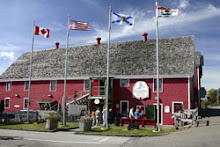
It was only a small part of life aboard a fishing schooner, like the Museum’s Theresa E. Connor, but it was important. It helped to give a sense of comfort, to both the men at sea and their families at home. Fishermen’s mittens are made on site at the Fisheries Museum of the Atlantic, here in Lunenburg, Nova Scotia.
Wishing you Smooth Sailing,
Heather
Showing posts with label superstitions. Show all posts
Showing posts with label superstitions. Show all posts
Thursday, January 31, 2008


Thursday, January 17, 2008
Knock three times
Hello Everyone,
No, the title isn't meant to be read as lines from an old song.
If anyone from Lunenburg and the surrounding area hears three knocks and there is no apparent source, it means only one thing: we've heard a forerunner.
Forerunners are never meant to be nasty or evil. They are warnings that someone we know, most often someone related to us, will die within three days of hearing the knocks. It's generally felt that this is to give us time to brace ourselves for the news of the loss.
There are stories of those who have been lost at sea who have come, in almost a ghostly apparition, to announce the news themselves. In many of these stories, the news of the loss of the fisherman is not confirmed for weeks. When the confirmation is received, it is revealed that the loss took place at almost the exact same time as the "forerunner".
While we don't pretend to know everything, there have been countless stories of forerunners in Lunenburg County, for many generations. Many of these stories conclude with confirmation of the passing of a loved one.
As Shakespeare once wrote, "There are more things in heaven and earth, Horatio, Than are dreamt of in your philosophy."
Wishing you Smooth Sailing,
Heather
Tuesday, January 15, 2008
Where Down is Never Up
Hello Everyone,
Planning a visit to Lunenburg, Nova Scotia? You’ll find that the folks are generally very friendly, the food is incredible, the tours of the town are fun and the museums are fabulous. We’re also one of Atlantic Canada’s leading cultural communities, with 19 art galleries. Old Town Lunenburg maintains its charm as a UNESCO World Heritage Site. This all takes place within a community of 2,300 people!
Superstitions have had a way of creeping into the lives of Lunenburgers for as long as memory can recall. Although some of the habits seem comical, it’s important to realize that the superstitions originated as a way for people to feel that they had control over uncontrollable aspects of their lives. In the age of sail, when loved ones were away from home for months at a time, families would do anything that they could, to protect those who were on the North Atlantic.
In my childhood, I watched my mother carefully follow the same ritual, each time she baked bread. The hot loaves would be carefully tipped, partly to one side, and eased out of their pans. They were then put upright, on cooling racks.
This didn’t seem odd to me. It was only after I began working at the Fisheries Museum of the Atlantic that I discovered that it is an age-old tradition. Whenever there were friends or family at sea, the women would never turn a pan upside down ... nor would they turn a loaf of bread upside down. The fear was that if they did, the schooner on which their loved ones were sailing would be caught in a storm and would capsize.
As I said, this was a way of dealing with daily fears. A strong belief in the superstitions gave a sense of control in lives that were forever fraught with uncontrollable elements of nature.
Wishing you Smooth Sailing,
Heather
Subscribe to:
Posts (Atom)