The earliest European fishing vessels that plied their trade on the North Atlantic were square-rigged ships. Fleets from various countries, including France and England, ploughed their way through the often stormy seas, and perched themselves atop the Grand Banks for several months of fishing.
It wasn’t an easy job.
The weather was cold, wet and miserable, even on the best of days. Many of the men who worked aboard the vessels, particularly the crew aboard French ships, were working off debts. Some had been taken from debtor’s prisons and were forced to work as fishermen, having left loved ones at home, to fend for themselves.
The earliest of these fishing vessels were similar to the famous HMS Bounty, but were not quite that developed, in terms of steering. These vessels did not have a ship’s wheel, but were steered by the use of a tiller stick, located aft, below deck. The captain or navigator would stand on deck and shouted directions down through a grill, to the man in charge of the tiller. Thankfully, they rarely had need for quick, nimble maneuvering.
Square-rigged vessels require a larger sized crew than schooner-rigged ships. In the case of these early fishing vessels, the fishermen had to also be able to climb aloft and work the sails. On their voyage to and from the banks, the sails were often set in the same position for days on end, harnessing winds that regularly blew from a steady direction. While on the banks, they stayed in one area for days or weeks, depending on the abundance of fish.
Showing posts with label fisheries museum of the atlantic. Show all posts
Showing posts with label fisheries museum of the atlantic. Show all posts
Monday, January 26, 2009


Monday, November 24, 2008
Family Photographs #1
This is the first in a series of articles about the care and investigation of family photographs.
Many of us have family photographs that have been passed from one generation to the next. However, we’re rarely lucky enough to have the names, dates and locations included with these treasures. This leads us to try our hand at unraveling the mysteries of the image; while we may never be able to answer all of the questions (like "why" the group has gathered together), we can still learn a lot and have fun.
The historic images that you have are at their peak, in terms of condition. Each passing year adds to their deterioration; visuals fade, the paper becomes weaker and accidents happen. One of the first things that you should do is make a copy of the photograph. Scan it or take it to a professional photography studio. Keep the original in archival-quality storage (search on-line or ask at a local museum or photography shop) and then work from your copied image. If you are fortunate to have the original negative, store it in an archival negative sheet. Again, discussing your concerns with museum or photography specialists is a wise choice.
This is probably a good time to realize that the photographs that you have from your own immediate past require tender care. Scan them to ensure that the images have a viable future and make a written record in terms of who is in the photograph, when it was taken, if it was a special occasion and the location. Never write on the back or front of the photograph! If you keep the images in an album, write on a piece of paper and insert it behind the image; if you are making a scrapbook type album, write beneath the image. At the Fisheries Museum of the Atlantic we often make a photocopy of a photograph and write on the photocopied page. In this way, we can mark on the image and not damage the original.
A further safety precaution is to keep copies of your images and the information in another location. You might consider making it a joint project with a relative, with each of you keeping copies. Remember, the finished product (or even the work-in-progress) makes a cherished keepsake for family members - a wonderful present to give and to receive!
Many of us have family photographs that have been passed from one generation to the next. However, we’re rarely lucky enough to have the names, dates and locations included with these treasures. This leads us to try our hand at unraveling the mysteries of the image; while we may never be able to answer all of the questions (like "why" the group has gathered together), we can still learn a lot and have fun.
The historic images that you have are at their peak, in terms of condition. Each passing year adds to their deterioration; visuals fade, the paper becomes weaker and accidents happen. One of the first things that you should do is make a copy of the photograph. Scan it or take it to a professional photography studio. Keep the original in archival-quality storage (search on-line or ask at a local museum or photography shop) and then work from your copied image. If you are fortunate to have the original negative, store it in an archival negative sheet. Again, discussing your concerns with museum or photography specialists is a wise choice.
This is probably a good time to realize that the photographs that you have from your own immediate past require tender care. Scan them to ensure that the images have a viable future and make a written record in terms of who is in the photograph, when it was taken, if it was a special occasion and the location. Never write on the back or front of the photograph! If you keep the images in an album, write on a piece of paper and insert it behind the image; if you are making a scrapbook type album, write beneath the image. At the Fisheries Museum of the Atlantic we often make a photocopy of a photograph and write on the photocopied page. In this way, we can mark on the image and not damage the original.
A further safety precaution is to keep copies of your images and the information in another location. You might consider making it a joint project with a relative, with each of you keeping copies. Remember, the finished product (or even the work-in-progress) makes a cherished keepsake for family members - a wonderful present to give and to receive!
Monday, August 18, 2008
Hello Everyone,
While listening to the Fisheries Museum of the Atlantic’s Maud R.M., complete with the put-put-put of an authentic make-and-break engine, I’m reminded that our shoreline waterways were once the main highway for coastal residents.
Whether people travelled by sail power or were propelled by oars or eventually by marine engines, the little boats of the coast linked island dwellers with the mainland. Trips to shore were carefully planned, incorporating trips to stores, visits with friends and relatives and rare appointments with doctors.
When make-and-break engines were first developed, at the turn of the 20th century, they gave an element of security to isolated communities. People were no longer dependent upon the weather; if it was "flat calm" they were still able to get to shore. More importantly, unless there was a vicious storm, they were able to go to shore to get doctors and members of the clergy, if there was an emergency at home.
The simple mechanics of the first marine engines made them user-friendly for those who had no previous experience with machinery.
The make and break experience is still available, for those who visit the Fisheries Museum of the Atlantic, in Lunenburg, Nova Scotia. The inshore boat replica, Maud R. M., putters around Lunenburg harbour at least once a week - and several lucky visitors to the Museum are able to take part in the tour!
Wishing you Smooth Sailing,
Heather
While listening to the Fisheries Museum of the Atlantic’s Maud R.M., complete with the put-put-put of an authentic make-and-break engine, I’m reminded that our shoreline waterways were once the main highway for coastal residents.
Whether people travelled by sail power or were propelled by oars or eventually by marine engines, the little boats of the coast linked island dwellers with the mainland. Trips to shore were carefully planned, incorporating trips to stores, visits with friends and relatives and rare appointments with doctors.
When make-and-break engines were first developed, at the turn of the 20th century, they gave an element of security to isolated communities. People were no longer dependent upon the weather; if it was "flat calm" they were still able to get to shore. More importantly, unless there was a vicious storm, they were able to go to shore to get doctors and members of the clergy, if there was an emergency at home.
The simple mechanics of the first marine engines made them user-friendly for those who had no previous experience with machinery.
The make and break experience is still available, for those who visit the Fisheries Museum of the Atlantic, in Lunenburg, Nova Scotia. The inshore boat replica, Maud R. M., putters around Lunenburg harbour at least once a week - and several lucky visitors to the Museum are able to take part in the tour!
Wishing you Smooth Sailing,
Heather
Monday, July 28, 2008
Ship to Shore ...
Hello Everyone,
This morning, Lunenburg’s front harbour is like a pond of burnished silver, reflecting the colours of the sky, paused with an pregnant hush. Will it rain? Will it clear? We don’t know.
It is an easy thing to stand on land and look out to the ocean, wondering what the weather conditions might bring. It is an entirely different matter to be on the ocean, especially aboard a fishing vessel, and be at the mercy of the whims of nature.
Now-a-days, with computers and a multitude of ship-to-shore communications, sudden storms rarely arrive without some form of advance warning. Mariners no longer have to base their survival on the rhyming ditties of old, including:
Red sky in the morning,
Sailors take warning.
Red sky at night,
Sailor’s delight.
Sadly, the change in communication has taken place only within the span of a lifetime. The turning point for Nova Scotian schooners came with the August Gales of 1926 and 1927. Although the technology had been available before that date, fishing schooners were not equipped with receivers until after the horrific loss of life in the Gales.
Although the hurricanes hit along the shore and caused wide-spread destruction, the Lunenburg fleet was hit particularly hard. In those two years, 138 fishermen aboard six Lunenburg schooners were lost. One of the keenest felt aspects of the tragedy is that those on land knew of the approaching storms, based on weather reports. The men aboard the schooners had no such luxury and unwittingly faced a dark future.
After the 1927 Gale, the Province of Nova Scotia made arrangements to have weather signals sent via radio, from Cape Breton. The owners of the schooners were instructed to install radio receivers aboard their vessels. Those two simple acts, previously avoided because of the expense, undoubtedly saved countless lives.
Wishing you Smooth Sailing,
Heather
This morning, Lunenburg’s front harbour is like a pond of burnished silver, reflecting the colours of the sky, paused with an pregnant hush. Will it rain? Will it clear? We don’t know.
It is an easy thing to stand on land and look out to the ocean, wondering what the weather conditions might bring. It is an entirely different matter to be on the ocean, especially aboard a fishing vessel, and be at the mercy of the whims of nature.
Now-a-days, with computers and a multitude of ship-to-shore communications, sudden storms rarely arrive without some form of advance warning. Mariners no longer have to base their survival on the rhyming ditties of old, including:
Red sky in the morning,
Sailors take warning.
Red sky at night,
Sailor’s delight.
Sadly, the change in communication has taken place only within the span of a lifetime. The turning point for Nova Scotian schooners came with the August Gales of 1926 and 1927. Although the technology had been available before that date, fishing schooners were not equipped with receivers until after the horrific loss of life in the Gales.
Although the hurricanes hit along the shore and caused wide-spread destruction, the Lunenburg fleet was hit particularly hard. In those two years, 138 fishermen aboard six Lunenburg schooners were lost. One of the keenest felt aspects of the tragedy is that those on land knew of the approaching storms, based on weather reports. The men aboard the schooners had no such luxury and unwittingly faced a dark future.
After the 1927 Gale, the Province of Nova Scotia made arrangements to have weather signals sent via radio, from Cape Breton. The owners of the schooners were instructed to install radio receivers aboard their vessels. Those two simple acts, previously avoided because of the expense, undoubtedly saved countless lives.
Wishing you Smooth Sailing,
Heather
Monday, July 14, 2008
Set Sail for Lunenburg!
Hello Everyone,
One of the most wonderful aspects of a Museum is that it can be the focal point in the sharing of history between those who have roots in an area and those who visit. Although this sharing of history happens every day, special events make the exchange even more meaningful.
The Fisheries Museum of the Atlantic, in Lunenburg, Nova Scotia, is nearing its anniversary. Each year, on 23 July, we celebrate the history of the Atlantic fishery, especially as it pertains to the Canadian coast.
This year, on 23 July, we’re celebrating both the anniversary of the Museum and the 70th anniversary year of the schooner Theresa E. Connor. Theresa E. Connor is the flagship of the Museum and we are tremendously excited to be celebrating 70 years of her history!
Theresa E. Connor is the oldest saltbank schooner in Canada. In almost 30 years of fishing, the vessel never lost a crew member. During the course of her career, the vessel fished both fresh and salt fishing. This meant that sometimes the catch was preserved on ice (fresh) and sometimes it was preserved in salt (salt fishing).
If you’re planning to head our way on Wednesday 23 July, you’ll be highly entertained! Special events, musical entertainment and historical re-enactments are part of the celebrations. Theresa E. Connor will be open, free-of-charge to the public on that day! Retired fishermen and heritage interpreters will make the vessel come to life, with demonstrations and talks.
Wishing you Smooth Sailing,
Heather
One of the most wonderful aspects of a Museum is that it can be the focal point in the sharing of history between those who have roots in an area and those who visit. Although this sharing of history happens every day, special events make the exchange even more meaningful.
The Fisheries Museum of the Atlantic, in Lunenburg, Nova Scotia, is nearing its anniversary. Each year, on 23 July, we celebrate the history of the Atlantic fishery, especially as it pertains to the Canadian coast.
This year, on 23 July, we’re celebrating both the anniversary of the Museum and the 70th anniversary year of the schooner Theresa E. Connor. Theresa E. Connor is the flagship of the Museum and we are tremendously excited to be celebrating 70 years of her history!
Theresa E. Connor is the oldest saltbank schooner in Canada. In almost 30 years of fishing, the vessel never lost a crew member. During the course of her career, the vessel fished both fresh and salt fishing. This meant that sometimes the catch was preserved on ice (fresh) and sometimes it was preserved in salt (salt fishing).
If you’re planning to head our way on Wednesday 23 July, you’ll be highly entertained! Special events, musical entertainment and historical re-enactments are part of the celebrations. Theresa E. Connor will be open, free-of-charge to the public on that day! Retired fishermen and heritage interpreters will make the vessel come to life, with demonstrations and talks.
Wishing you Smooth Sailing,
Heather
Thursday, July 3, 2008
Memories - August Gales
Hello Everyone,
Every Nova Scotian coastal community owes some part of its history and prosperity to those who went fishing. Whether they worked from small inshore fishing boats or went to sea in schooners or trawlers, their life’s work meant prosperity for their villages and towns. The industry continues today and is just as important, although technology and the diminished fish stocks have changed the tenor of the activity.
Older fishermen often said, when pressed, that they did not like to talk to their families about the close calls that they had at sea. There was no point in worrying those at home and they were simply thankful to have survived.
Other stories became known, however, because of the extent of the tragedy that was involved. The fishermen did not live to come home; their loss made headlines, instead.
The August Gales that hit near Sable Island, in 1926 and 1927, took the lives of at least 138 Lunenburg-based fishermen. In total, six Lunenburg vessels were lost, with all hands. The tragedy did not confine itself to the Lunenburg area; devastation was felt all along the coastline.
In the August Gale of 1927, the last of the all-sail Gloucester schooners, Columbia, was lost at Sable Island. The crew of 22 were all from Nova Scotia, from the Queens County and Shelburne County areas.
One of the most poignant stories is that of Shelburne County crewman Allister Firth, who was just 17. He was lost with the rest of the crew, including his father, Arthur.
Young Allister did not want to go to sea that trip. He was a musician and wanted to play the violin. The family, however, was poor and the small wage that Allister could earn at sea was important. It became a source of great dispute between Allister and his father. On the day of sailing, the young lad hid in a closet in the home of a relative. His father found him, dragged him down the dock to the schooner, and threatened him that he had to go aboard Columbia and stay there. Arthur went and got their belongings and settled aboard the vessel.
Within weeks, the August Gale dealt crushing blows to the schooners caught in its grip. Columbia, with young Allister, was lost without a trace.
As a curious side-note, a few winters later, an American trawler was fishing in that area. It was night, but they were steaming along, when suddenly they caught hold of something heavy. The command was given to raise the trawl and, in the beam of light from the trawler, the crew was astounded to see the wreck of the schooner Columbia break the surface and pause for a few minutes. The lines then broke and the famous fishing and racing schooner dipped beneath the waves, for the last time.
The Fisheries Museum of the Atlantic, in Lunenburg, Nova Scotia, has a detailed exhibit about the August Gales of 1926 and 1927, with photographs of many of the men who were lost.
Wishing you Smooth Sailing,
Heather
Every Nova Scotian coastal community owes some part of its history and prosperity to those who went fishing. Whether they worked from small inshore fishing boats or went to sea in schooners or trawlers, their life’s work meant prosperity for their villages and towns. The industry continues today and is just as important, although technology and the diminished fish stocks have changed the tenor of the activity.
Older fishermen often said, when pressed, that they did not like to talk to their families about the close calls that they had at sea. There was no point in worrying those at home and they were simply thankful to have survived.
Other stories became known, however, because of the extent of the tragedy that was involved. The fishermen did not live to come home; their loss made headlines, instead.
The August Gales that hit near Sable Island, in 1926 and 1927, took the lives of at least 138 Lunenburg-based fishermen. In total, six Lunenburg vessels were lost, with all hands. The tragedy did not confine itself to the Lunenburg area; devastation was felt all along the coastline.
In the August Gale of 1927, the last of the all-sail Gloucester schooners, Columbia, was lost at Sable Island. The crew of 22 were all from Nova Scotia, from the Queens County and Shelburne County areas.
One of the most poignant stories is that of Shelburne County crewman Allister Firth, who was just 17. He was lost with the rest of the crew, including his father, Arthur.
Young Allister did not want to go to sea that trip. He was a musician and wanted to play the violin. The family, however, was poor and the small wage that Allister could earn at sea was important. It became a source of great dispute between Allister and his father. On the day of sailing, the young lad hid in a closet in the home of a relative. His father found him, dragged him down the dock to the schooner, and threatened him that he had to go aboard Columbia and stay there. Arthur went and got their belongings and settled aboard the vessel.
Within weeks, the August Gale dealt crushing blows to the schooners caught in its grip. Columbia, with young Allister, was lost without a trace.
As a curious side-note, a few winters later, an American trawler was fishing in that area. It was night, but they were steaming along, when suddenly they caught hold of something heavy. The command was given to raise the trawl and, in the beam of light from the trawler, the crew was astounded to see the wreck of the schooner Columbia break the surface and pause for a few minutes. The lines then broke and the famous fishing and racing schooner dipped beneath the waves, for the last time.
The Fisheries Museum of the Atlantic, in Lunenburg, Nova Scotia, has a detailed exhibit about the August Gales of 1926 and 1927, with photographs of many of the men who were lost.
Wishing you Smooth Sailing,
Heather
Monday, June 30, 2008
Blowing in the Wind
Hello Everyone,
As noted several times, the Fisheries Museum of the Atlantic is perched on the edge of Lunenburg’s front harbour.
Our front harbour has been witness to a great deal of history. The month of June always puts me in mind of Lunenburg’s first settlers. The Foreign Protestants who first populated our town came in two small waves of settlement, arriving on June 8 and June 17.
The weather played havoc with the plans and good intentions of the British military, who organized the settlement.
The initial flotilla of 14 transport ships that brought the first Lunenburgers to port, left Halifax at the end of May. The trip was expected to take only a day or two, but provisions for one week were packed, to ensure victuals for the voyage and the first few days in their new home.
Unfortunately, crew members eager to embark on their voyage put the provisions deep in the holds of the vessels, along with the settler’s baggage. Food and water were inaccessible. While the vessels waited out a period of "flat calm breeze" (i.e., no wind), word was sent to Halifax that fresh provisions were required. Settlers and crew waited a week before they were able to get a good sailing wind. Very early on the morning of June 7th, they left a cove near Halifax and ventured forth.
The early hours of June 8 saw the first Foreign Protestants grace the surface of Lunenburg’s front harbour. The second wave arrived on June 17, after a mere two days at sea.
From that point onward, the fine settlers put down roots and established a world-famous seaport - although most of the first generation Foreign Protestants were farmers!
Wishing you Smooth Sailing,
Heather
As noted several times, the Fisheries Museum of the Atlantic is perched on the edge of Lunenburg’s front harbour.
Our front harbour has been witness to a great deal of history. The month of June always puts me in mind of Lunenburg’s first settlers. The Foreign Protestants who first populated our town came in two small waves of settlement, arriving on June 8 and June 17.
The weather played havoc with the plans and good intentions of the British military, who organized the settlement.
The initial flotilla of 14 transport ships that brought the first Lunenburgers to port, left Halifax at the end of May. The trip was expected to take only a day or two, but provisions for one week were packed, to ensure victuals for the voyage and the first few days in their new home.
Unfortunately, crew members eager to embark on their voyage put the provisions deep in the holds of the vessels, along with the settler’s baggage. Food and water were inaccessible. While the vessels waited out a period of "flat calm breeze" (i.e., no wind), word was sent to Halifax that fresh provisions were required. Settlers and crew waited a week before they were able to get a good sailing wind. Very early on the morning of June 7th, they left a cove near Halifax and ventured forth.
The early hours of June 8 saw the first Foreign Protestants grace the surface of Lunenburg’s front harbour. The second wave arrived on June 17, after a mere two days at sea.
From that point onward, the fine settlers put down roots and established a world-famous seaport - although most of the first generation Foreign Protestants were farmers!
Wishing you Smooth Sailing,
Heather
Friday, June 20, 2008

Hello Everyone,
The Fisheries Museum of the Atlantic is heavily involved with the Toronto Nautical Festival, running this weekend (Friday, 20 June to Sunday). In addition to a fine display booth highlighting both the Museum and the town of Lunenburg, our boat builder is constructing a Lunenburg dory at the Festival.
The Province of Nova Scotia has also sent Lunenburg's fine ambassador, Bluenose II, to be the flagship of the event. The Province issued the following press release:
Nova Scotia's sailing ambassador, the world famous schoonerBluenose II, is sailing into Toronto, bringing with it the sights and sounds of Canada's seacoast province. The visit is part of the 2008 Nautical Festival at the Toronto Harbourfront Thursday, June 19 to Sunday, June 22. "We are thrilled to have Bluenose II at the Toronto Nautical Festival," said Bill Dooks, Minister of Tourism, Culture and Heritage. "While she was born in Nova Scotia, Bluenose II is a symbol of endurance and achievement for all Canadians and remains a wonderful ambassador for our province."
The event will feature a Nova Scotian pavilion, including a wide range of industry professionals demonstrating new products, sharing experiences and offering samples from Canada's seacoast province. It will also give the public an opportunity to stroll the deck of Bluenose II.
Popular entertainers, such as the Barra MacNeils, will perform at the festival, immersing Toronto residents in Nova Scotia's rich and lively music. Information about Nova Scotia as a travel destination will be featured at the Nautical Festival. Included will be an outline of air travel options available to those interested in visiting Nova Scotia from Toronto's Pearson International and City Centre airports.
The original Bluenose was launched from a shipyard in Lunenburg on March 26, 1921. Because of wins in the races of Grand Banks schooners between Canada and the U.S., the Bluenose became known as Queen of the North Atlantic. In 1963, the ship's replica, Bluenose II, was launched from the same shipyard, also built by many of the same men who worked on the original Bluenose.
=====
If you're in Toronto this weekend, drop in an visit with our staff from the Fisheries Museum of the Atlantic!
Wishing you Smooth Sailing,
Heather
Thursday, June 19, 2008
Looks can be Deceiving

Hello Everyone,
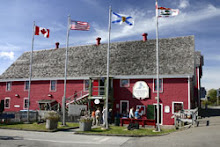
Brightly painted red buildings on the waterfront in Lunenburg, Nova Scotia are eye-catching, gorgeous and almost a dime-a-dozen. The Fisheries Museum of the Atlantic stands out from the crowd, with a large parking lot and attractive flags at the entrance, but for those who approach by land and not sea, looks can be deceiving.
Many first-time visitors to the Museum have no idea how large the site is, with several inter-connected buildings, an authentic fishing schooner, a retired fishing trawler (both open to the public), a theatre, exhibits and an aquarium.
The boat shop, at the far end of the property, is often a hive of activity. The boat builder constructs dories, as well as special projects of various types of small boats.
The Whaling and Whales exhibit is tremendously popular, especially with school groups. A traditional, albeit Norwegian, whale arch frames the entrance. The arch is composed of the jaw bones of a fin whale. Laughter and excitement bubble to the fore, when students measure out the length of fin and blue whales, on the wharf.
Described as friendly and fascinating, the Fisheries Museum of the Atlantic has many exhibits and activities for visitors. Rather than being "too small", the Museum offers delights that have enraptured visitors for many hours, as well as days!
Wishing you Smooth Sailing,
Heather
Wednesday, June 18, 2008
Ride the Lobster!
Hello Everyone,
The Fisheries Museum of the Atlantic is open for the summer season, with more activities and delights than you would ordinarily imagine.
One of the special events that came our way is the Ride the Lobster ( www.ridethelobster.com ) unicycle race! It is an international race, with 36 teams racing 800 km along the length of Nova Scotia (apparently we’re the crustacean-shaped province).
The cyclists came rushing through Lunenburg, yesterday, and the Fisheries Museum of the Atlantic was one of the official check-in stations. It was simply amazing to see the riders balanced atop large unicycles, cycling at speeds of upwards of 25 km per hour. On the open highway, the more experienced racers are able to go even faster.
One of the special treats that we had on-site for the afternoon was a trio from the Lunenburg County Fiddlers. They blended into the festive spirit of the day, with their lively Down East music. One of the unicycle team members, a fellow from British Columbia, was ecstatic with the chance to listen and to perform with the group. A trained violinist, he has been picking up various forms of violin (or fiddle) music - and his dulcet tones and remarkable ability enriched the musical experience for everyone.
Ride the Lobster continues through the rest of the week, moving into Cape Breton for the grand finale.
Wishing you Smooth Sailing,
Heather
The Fisheries Museum of the Atlantic is open for the summer season, with more activities and delights than you would ordinarily imagine.
One of the special events that came our way is the Ride the Lobster ( www.ridethelobster.com ) unicycle race! It is an international race, with 36 teams racing 800 km along the length of Nova Scotia (apparently we’re the crustacean-shaped province).
The cyclists came rushing through Lunenburg, yesterday, and the Fisheries Museum of the Atlantic was one of the official check-in stations. It was simply amazing to see the riders balanced atop large unicycles, cycling at speeds of upwards of 25 km per hour. On the open highway, the more experienced racers are able to go even faster.
One of the special treats that we had on-site for the afternoon was a trio from the Lunenburg County Fiddlers. They blended into the festive spirit of the day, with their lively Down East music. One of the unicycle team members, a fellow from British Columbia, was ecstatic with the chance to listen and to perform with the group. A trained violinist, he has been picking up various forms of violin (or fiddle) music - and his dulcet tones and remarkable ability enriched the musical experience for everyone.
Ride the Lobster continues through the rest of the week, moving into Cape Breton for the grand finale.
Wishing you Smooth Sailing,
Heather
Thursday, March 20, 2008
Upcoming Season at Fisheries Museum
No matter what the season, one of the most delightful ways to spend a few hours, or an entire day, is a visit to Lunenburg’s Fisheries Museum of the Atlantic. Several major exhibits are open year-round, Monday - Friday (holidays excepted). In the winter and early spring, Wednesday mornings are Movie Mornings, with showings from the Museum’s heritage collection, at 10:00 a.m.
Full season programming begins on May 17, with visitors encouraged to explore many aspects of Nova Scotia’s maritime heritage. Exciting activities and a wonderful salt and fresh water aquarium engage people of all ages. Exhibit topics include rum running, losses at sea, the famous Bluenose and the history of fishing on the Banks.
2008 marks the 70th anniversary of the launch of Canada’s oldest saltbank schooner, Theresa E. Connor. The flagship of the Fisheries Museum of the Atlantic, Theresa E. Connor is a tribute to all schooners that plied their trade on the Banks. Stepping aboard the vessel is like going back in time, where you can see a schooner ready for work and talk with men who fished on the Banks.
Cape Sable, a steel-hulled side trawler, is also open to the public, with retired fishermen sharing stories of their times at sea.
Local maritime heritage is celebrated in many ways, at the Museum. Special events are scheduled throughout the season, but every day is a special day, with thrilling discoveries and activities. Visitors enjoy the ultimate waterfront experience, at the Fisheries Museum of the Atlantic.
Full season programming begins on May 17, with visitors encouraged to explore many aspects of Nova Scotia’s maritime heritage. Exciting activities and a wonderful salt and fresh water aquarium engage people of all ages. Exhibit topics include rum running, losses at sea, the famous Bluenose and the history of fishing on the Banks.
2008 marks the 70th anniversary of the launch of Canada’s oldest saltbank schooner, Theresa E. Connor. The flagship of the Fisheries Museum of the Atlantic, Theresa E. Connor is a tribute to all schooners that plied their trade on the Banks. Stepping aboard the vessel is like going back in time, where you can see a schooner ready for work and talk with men who fished on the Banks.
Cape Sable, a steel-hulled side trawler, is also open to the public, with retired fishermen sharing stories of their times at sea.
Local maritime heritage is celebrated in many ways, at the Museum. Special events are scheduled throughout the season, but every day is a special day, with thrilling discoveries and activities. Visitors enjoy the ultimate waterfront experience, at the Fisheries Museum of the Atlantic.
Wednesday, March 5, 2008
The Courage To Do The Impossible ...
Marlon Brando in "Mutiny on the Bounty". Russell Crowe in "Master and Commander". Captain Angus Walters aboard the famous Bluenose.
What do these three men have in common? The connection is found through their vessels; the replicas of the HMS Bounty and the HMS Rose (later HMS Surprise) and the original Bluenose were all built at the Smith and Rhuland Shipyard, in Lunenburg Nova Scotia.
The replica of HMS Bounty was launched in 1960, to the cheers of thousands of Lunenburgers and visitors to the community. It sparked the movement to build a replica of our own Bluenose, and in 1963, Bluenose II slid down the ways at the Smith and Rhuland Shipyard.
In 1970, the replica of HMS Rose was constructed at the same Yard. Marine history buffs were delighted to see another part of nautical history come to life under the skilled hands of Lunenburg craftsmen. In 2003, HMS Rose was immortalized in the release of "Master and Commander", as the vessel HMS Surprise. In honour of that role, the name of the ship was officially changed to HMS Surprise.
The Smith and Rhuland Shipyard was one of the best-known shipyards in Nova Scotia. Located on the Lunenburg waterfront, the Yard produced more than one hundred fine ships. The Shipyard was the creation of Richard Smith and George Rhuland and was established in 1900. In their first year, they built two vessels: Palatia and Quisetta.
From 1900 until the mid-1970s, many vessel designs went from half-models to full-sized craft. Fishing vessels, like the Fisheries Museum of the Atlantic’s Theresa E. Connor were built there, as were larger "ocean-going" ships. Vessels that were used for pleasure craft and in serious work went hand-in-glove with other, adventurous ships ~ like rum runners!
The mainstay of the Smith and Rhuland Shipyard, though, remained in the fishery. The fine vessels, the shipwrights that crafted them and the men who sailed them can all be brought together under the same tagline used in the movie "Master and Commander": The Courage To Do The Impossible Lies in the Hearts of Men.
For every fisherman who has gone to sea and for their brave families on shore, the Fisheries Museum of the Atlantic celebrates their dreams and honours their sacrifices.
Wishing you Smooth Sailing,
Heather
What do these three men have in common? The connection is found through their vessels; the replicas of the HMS Bounty and the HMS Rose (later HMS Surprise) and the original Bluenose were all built at the Smith and Rhuland Shipyard, in Lunenburg Nova Scotia.
The replica of HMS Bounty was launched in 1960, to the cheers of thousands of Lunenburgers and visitors to the community. It sparked the movement to build a replica of our own Bluenose, and in 1963, Bluenose II slid down the ways at the Smith and Rhuland Shipyard.
In 1970, the replica of HMS Rose was constructed at the same Yard. Marine history buffs were delighted to see another part of nautical history come to life under the skilled hands of Lunenburg craftsmen. In 2003, HMS Rose was immortalized in the release of "Master and Commander", as the vessel HMS Surprise. In honour of that role, the name of the ship was officially changed to HMS Surprise.
The Smith and Rhuland Shipyard was one of the best-known shipyards in Nova Scotia. Located on the Lunenburg waterfront, the Yard produced more than one hundred fine ships. The Shipyard was the creation of Richard Smith and George Rhuland and was established in 1900. In their first year, they built two vessels: Palatia and Quisetta.
From 1900 until the mid-1970s, many vessel designs went from half-models to full-sized craft. Fishing vessels, like the Fisheries Museum of the Atlantic’s Theresa E. Connor were built there, as were larger "ocean-going" ships. Vessels that were used for pleasure craft and in serious work went hand-in-glove with other, adventurous ships ~ like rum runners!
The mainstay of the Smith and Rhuland Shipyard, though, remained in the fishery. The fine vessels, the shipwrights that crafted them and the men who sailed them can all be brought together under the same tagline used in the movie "Master and Commander": The Courage To Do The Impossible Lies in the Hearts of Men.
For every fisherman who has gone to sea and for their brave families on shore, the Fisheries Museum of the Atlantic celebrates their dreams and honours their sacrifices.
Wishing you Smooth Sailing,
Heather
Monday, March 3, 2008
Lunenburg on the Money!

Hello Everyone,
We’ve always said that the smell of fish, when being made into various products at a fish processing plant, is the "smell of money". I’m sure that Lunenburg is not alone in that regard. Fish processing, whether it was in the days of salt fish or in modern plants, has been the economic backbone of coastal communities.
The Museum schooner Theresa E. Connor played a successful part in the economy of Nova Scotia, from 1938 until 1966. The vessel was originally owned by the Halifax-based National Fish Company.
However, Theresa E. Connor has an added connection with the Canadian economy. The Canadian one hundred dollar bill, issued from May 1976 until December 1990, had a picture of three vessels on the Lunenburg waterfront. It was part of the Bank of Canada’s "Scenes of Canada Series". The vessels were, from left to right, Lilla B. Boutilier, E. P. Theriault and Theresa E. Connor. The schooner Lilla B. Boutilier was the sister ship to Theresa E. Connor. The original photograph, from which the engraving was copied, dates to early 1939.
On 3 December 1990, the Birds of Canada Series one hundred dollar bill was first issued. The front of the bank note remained the same, with Prime Minister Robert Borden. The reverse showed the Canada goose.
Wishing you Smooth Sailing,
Heather
Monday, February 18, 2008
A Fish Gone Bad
Hello Everyone,
Perhaps the greatest disservice done to the good name of fish has been the wide-spread assumption that if something smells like a fish, it’s "off". It does not smell good. It has been part of our language for generations: if a statement seems "fishy", we know that there is something bad about it. A fishy excuse, as teachers all recognize, is no excuse at all!
A fresh fish has virtually no smell. In fact, it has a freshness of scent that is quite delightful.
A fish that is not so fresh, however, has that unmistakable smell of a fish gone bad.
When buying fish at your market, the sniff-test is essential. Yes, asking the fishmonger if the fish is fresh is a sensible question, but you need to examine the product before you buy it. Honest sellers may recommend buying fish and seafood frozen at sea, if their "fresh" fish is not top of the line.
Thoughts of fishy smells have transcended into misconceptions about fishing vessels. There are those who equate a fishing boat with a vessel that is unkempt and unclean. Any fisherman knows that the vessels and all of the on-board gear need to be kept scrupulously clean.
A description of the Fisheries Museum of the Atlantic’s Theresa E. Connor, from the November 1944 edition of "Canadian Fisherman":
While the gang were dressing down, I went below to the fish-hold to see what it was like. Located in the waist of the schooner, it was quite a lengthy compartment and also occupied the whole width of the vessel. Walls and partitions were painted white and shone dazzingly [sic] in the glow of the electric lights. The air below deck was clean and fresh and not stagnant and odorous with the smell of fish as I expected it would be. Were it not for the chill of the atmosphere I would have fancied myself in a hospital corridor. With our vessel just come from having been completely overhauled I thought that this cleanliness was exceptional, but some of the men working below assured me that such was not the case. "The fish-hold has to be clean," said one. "We have to keep washing these storage pens after every trip, or they would go sour on us and spoil the fish."
Wishing you Smooth Sailing,
Heather
Perhaps the greatest disservice done to the good name of fish has been the wide-spread assumption that if something smells like a fish, it’s "off". It does not smell good. It has been part of our language for generations: if a statement seems "fishy", we know that there is something bad about it. A fishy excuse, as teachers all recognize, is no excuse at all!
A fresh fish has virtually no smell. In fact, it has a freshness of scent that is quite delightful.
A fish that is not so fresh, however, has that unmistakable smell of a fish gone bad.
When buying fish at your market, the sniff-test is essential. Yes, asking the fishmonger if the fish is fresh is a sensible question, but you need to examine the product before you buy it. Honest sellers may recommend buying fish and seafood frozen at sea, if their "fresh" fish is not top of the line.
Thoughts of fishy smells have transcended into misconceptions about fishing vessels. There are those who equate a fishing boat with a vessel that is unkempt and unclean. Any fisherman knows that the vessels and all of the on-board gear need to be kept scrupulously clean.
A description of the Fisheries Museum of the Atlantic’s Theresa E. Connor, from the November 1944 edition of "Canadian Fisherman":
While the gang were dressing down, I went below to the fish-hold to see what it was like. Located in the waist of the schooner, it was quite a lengthy compartment and also occupied the whole width of the vessel. Walls and partitions were painted white and shone dazzingly [sic] in the glow of the electric lights. The air below deck was clean and fresh and not stagnant and odorous with the smell of fish as I expected it would be. Were it not for the chill of the atmosphere I would have fancied myself in a hospital corridor. With our vessel just come from having been completely overhauled I thought that this cleanliness was exceptional, but some of the men working below assured me that such was not the case. "The fish-hold has to be clean," said one. "We have to keep washing these storage pens after every trip, or they would go sour on us and spoil the fish."
Wishing you Smooth Sailing,
Heather
Friday, February 15, 2008
Canada's Oldest Saltbank Schooner

Hello Everyone,
The flagship of the Fisheries Museum of the Atlantic is the retired fishing schooner Theresa E. Connor. Launched on 14 December 1938, from the Smith and Rhuland Shipyard in Lunenburg, Nova Scotia, the vessel fished until the mid-1960s. In 1967, as Lunenburg’s Centennial of Confederation project, Theresa E. Connor was unveiled as the Lunenburg Fisheries Museum.
The schooner is important because it is representative of thousands of two-masted fishing schooners that plied their trade all along the Atlantic coast of Canada and the United States. In turn, crew life aboard Theresa E. Connor also speaks of the lives of hundreds of thousands of fishermen.
As a saltbank schooner, Theresa E. Connor fished on the fishing banks near Newfoundland and Labrador, as well as those nearer Nova Scotia. The men fished from dories and brought their catch back to the mother schooner. The fish, mostly cod, were cleaned and then preserved in salt, in the hold of the vessel.
Theresa E. Connor was launched into a time that included steel trawlers. The last of the schooners fished virtually side-by-side with side trawlers that hauled their catch aboard their vessels with huge nets.
The fishing history of Theresa E. Connor ended on a bitter-sweet note. In May 1963, Captain Harry Oxner prepared the schooner for one final trip to the Banks. With a few Lunenburg-area fishermen, he set sail for Fortune Bay, Newfoundland, to get the remainder of his crew.
Unfortunately, the steady march of progress and technology made it impossible for him to get additional crew members for the last salt fishing trip. No one was willing to undertake the danger and hard work of dory fishing, when they had the chance to go on trawlers. Although the work was still hard and dangerous, they did not risk the danger of being lost in a dory.
The schooner spent the remainder of 1963 fishing with cod traps, in the Labrador fishery. Theresa E. Connor continued to fish, in a reduced capacity, for Zwicker and Company (Lunenburg) until 1966. The vessel was then sold to the Lunenburg Marine Museum Society.
Since then, hundreds of thousands of visitors have been welcomed aboard the schooner. The retired fishing captains who now work aboard the vessel share their experiences with people from around the world, keeping the memories alive for new generations.
Wishing you Smooth Sailing,
Heather
Thursday, February 14, 2008
Sailor's Valentines

Happy St. Valentine’s Day Everyone,
The Fisheries Museum of the Atlantic has many precious stories, artifacts and images in its collection. On a day like today, though, two items stand out above the rest: our Sailor’s Valentines.
Sailor’s Valentines are relatively flat, hinged boxes, often octagonal in shape. When opened, the viewer is treated to two panels (one in each half) of shells, which have been arranged in gaily coloured designs. Messages are sometimes included, with small seed shells spelling out words of devotion.
Mariners were often away from home for long periods of time. Although the best-known trips were aboard whaling vessels, the North Atlantic fishermen also had their trips "away". When the salt fish were properly cured (dried), the shipments were sent to places as far away as Spain, Portugal, England, the West Indies and South America. Some members of the fishing crews would spend months going to and fro, taking the salt fish to the buyers and returning with cargoes of rum, salt, molasses, bananas, coconuts and other items.
It was during their runs to the south, including voyages to the West Indies, that gave fishermen the opportunity to get shells to craft their Sailor’s Valentines. If they were not artistically inclined, a visit to the West Indies also gave them a chance to buy a Sailor’s Valentine already fashioned with the exotic local shells.
Wishing you Smooth Sailing,
Heather
Monday, February 11, 2008
It's Good For You!

Cod Liver Oil
Did your spine seem to shiver, when you read those three words?
If so, then you are probably one of countless individuals, from around the globe, who had to shudder and swallow your morning dose of cod liver oil, with the parental admonition of "It’s good for you!"
Others grew up with a daily ration of halibut liver oil and still some of us had the added bonus of having it given to us in capsule form, rather than the golden liquid in a spoon. A word to the wise: no matter how much trouble you have when swallowing a capsule, do not give in to the urge to bite it.
Now-a-days, the health benefits of an omega-3 oil rich diet are well documented. It just so happens that cod liver oil is an excellent source of this nutrient. Our parents knew what they were talking about, when they said that it would keep us healthy!
Whether we consume the fish oil in the liquid or encapsulated form, we are ingesting processed oil from the fish livers. It’s a step up from what the hardy fishermen of the North Atlantic often took, while at sea.
The schooner fishermen carefully preserved the cod livers in barrels, or butts. The butts were in place amidships, on the deck of the schooners. The oil would be rendered from the livers by putting a metal "stack" deep into the butts. This stack resembled a chimney pipe and held burning hot coals. The heat caused the livers to release the oil.
During the worst of the fishing seasons, when the price of fish was exceptionally low, the fishermen would sometimes earn more money from the sale of the cod liver oil than they did for their catch of fish.
How tough were the fishermen? Many fishing trips have been described with the comments that the fishermen, when they would first come on deck in the morning, would go to the liver butts, take a scoop of raw liver oil and drink it without a blink of an eye.
The thought of it is almost enough to make us feel nostalgic for the spoons of processed oil that were offered to us!
Wishing you Smooth Sailing,
Heather
Friday, February 8, 2008
March Break Ahead!

Hello Everyone,
Glimpses of sunshine and a renewed freshness in the air give hope of springtime, even when we are going from pillar to post between snowstorms.
The Fisheries Museum of the Atlantic, in Lunenburg, Nova Scotia, is making plans to celebrate during next month’s spring break for school students. The March Break takes place between March 10 - 14, in Nova Scotia.
Special events will be held each day, at the Museum. Highlights include building your very own Styrofoam tugboat with the help of the South Shore Ship Modeller’s Guild. This enthusiastic group of volunteers will be at the Museum on Friday, March 14, with the programme running at 10 a.m. and 2 p.m.
Other activities will include films, crafts and stories. Our aquarium, as well as other exhibits, will be open to the public, ensuring that there is something fun for everyone!
Please check our website, http://fisheries.museum.gov.ns.ca for updates for the March Break Special Events. Pre-booking for registration will ensure that you have a space. Registration can be done by email, smithls@gov.ns.ca or by calling the Museum at 902-634-4794.
Wishing you Smooth Sailing,
Heather
Thursday, February 7, 2008
Dory Fishing
Hello Everyone,
The Fisheries Museum of the Atlantic is perched on the edge of Lunenburg’s front harbour. In fact, we’re actually out over the edge, between land and sea, with some of our buildings and the wharves. Our largest vessels, the schooner Theresa E. Connor and the trawler Cape Sable, float alongside, at dock.
Lunenburg really does offer the best of both worlds: history is alive within this UNESCO World Heritage Site and modern technology thrives, with businesses such as HB Studios and Composites Atlantic.
Given that this is not the land where time stood still, it is heartening to look out at the harbour and see authentic Lunenburg dories being rowed. The young women and men who practice their rowing skills in the dories are doing it for many reasons, including the International Dory Races, which are held each year.
The Lunenburg Dory is as essential to the story of the schooner fishery as the larger vessels themselves. Dory fishing changed the landscape of Lunenburg and all coastal communities that were involved in the schooner fishery.
Although there is scholarly debate in terms of when dory fishing began, the date is usually set in the 1850s. As late as the 1830s-1870s, fishermen fished from the decks of the schooners, each using one or two long fishing lines. This began to change on this coast in the 1850s, when enterprising American fishermen began to go out in dories, from the mother schooner. This was called "single dory fishing", as each dory contained only one fisherman. They still fished with one to three lines (one would be tied to a tholepin).
In the 1860s, double dory (larger dories with two men) fishing changed the schooner fishery forever. Instead of a few lines, with one or two hooks each, fishermen now set long lines of trawl, with thousands of hooks per dory. The resultant economic boom in the fisheries meant that communities enjoyed financial rewards far beyond anything that had gone before that time.
In Lunenburg, double dory fishing began in 1873, with Captain Benjamin Anderson at the helm of the schooner Dielytris. He took four dories and a crew of 13. Four other vessels were similarly equipped and went with him to the Western Banks, near Sable Island. The companion schooners went home, quickly disheartened with the experiment. Captain Anderson stayed on and had a very successful fishing trip.
Dory fishing caused such a dramatic change in the industry that Lunenburg went from a fishing community with 15 schooners, in the mid-1800s, to a thriving port that was home to more than 100 schooners at the turn of the 20th century.
Wishing you Smooth Sailing,
Heather
The Fisheries Museum of the Atlantic is perched on the edge of Lunenburg’s front harbour. In fact, we’re actually out over the edge, between land and sea, with some of our buildings and the wharves. Our largest vessels, the schooner Theresa E. Connor and the trawler Cape Sable, float alongside, at dock.
Lunenburg really does offer the best of both worlds: history is alive within this UNESCO World Heritage Site and modern technology thrives, with businesses such as HB Studios and Composites Atlantic.
Given that this is not the land where time stood still, it is heartening to look out at the harbour and see authentic Lunenburg dories being rowed. The young women and men who practice their rowing skills in the dories are doing it for many reasons, including the International Dory Races, which are held each year.
The Lunenburg Dory is as essential to the story of the schooner fishery as the larger vessels themselves. Dory fishing changed the landscape of Lunenburg and all coastal communities that were involved in the schooner fishery.
Although there is scholarly debate in terms of when dory fishing began, the date is usually set in the 1850s. As late as the 1830s-1870s, fishermen fished from the decks of the schooners, each using one or two long fishing lines. This began to change on this coast in the 1850s, when enterprising American fishermen began to go out in dories, from the mother schooner. This was called "single dory fishing", as each dory contained only one fisherman. They still fished with one to three lines (one would be tied to a tholepin).
In the 1860s, double dory (larger dories with two men) fishing changed the schooner fishery forever. Instead of a few lines, with one or two hooks each, fishermen now set long lines of trawl, with thousands of hooks per dory. The resultant economic boom in the fisheries meant that communities enjoyed financial rewards far beyond anything that had gone before that time.
In Lunenburg, double dory fishing began in 1873, with Captain Benjamin Anderson at the helm of the schooner Dielytris. He took four dories and a crew of 13. Four other vessels were similarly equipped and went with him to the Western Banks, near Sable Island. The companion schooners went home, quickly disheartened with the experiment. Captain Anderson stayed on and had a very successful fishing trip.
Dory fishing caused such a dramatic change in the industry that Lunenburg went from a fishing community with 15 schooners, in the mid-1800s, to a thriving port that was home to more than 100 schooners at the turn of the 20th century.
Wishing you Smooth Sailing,
Heather
Wednesday, February 6, 2008
Bluenose II
Hello Everyone,
When I look out my office window, at the Fisheries Museum of the Atlantic, in Lunenburg, Nova Scotia, part of my immediate view is of the ratlines of the schooner Bluenose II. A closer look reveals the masts and deck of this famous sailing ambassador of Nova Scotia.
Bluenose II is owned by the Province of Nova Scotia and is operated by the Board of Directors of the Lunenburg Marine Museum Society. This same organization operates the Fisheries Museum of the Atlantic for the Nova Scotia Museum.
Bluenose II is history renewed, revitalized and alive. Built at the Smith and Rhuland Shipyard, here in Lunenburg, in 1963, Bluenose II is a tribute to the original Bluenose, built at the same Yard in 1921.
The original vessel won international acclaim as the undefeated champion of the North Atlantic. Bluenose raced against the best of the American fishing schooners, in the International Fishermen’s Series, from 1921 to the last race in 1938, winning each Series. The schooner was a fishing vessel, a racer and an ambassador, travelling as far as England during the King’s Jubilee in 1935.
Bluenose II has made her own splash in history and continues to bring the experience of going to sea alive for both crew and visitors. Each year, Bluenose II travels to a variety of ports and welcomes thousands of visitors aboard. Short cruises are available, when weather permits.
Nothing compares to the sound of the sails filled with a breeze, on the great Atlantic, or even in the waters of the St. Lawrence River and the Great Lakes.
In 2008, the ports of call include Gaspé, Montréal, Toronto, Quebec City, Gloucester and, for the first time, Sainte-Pierre.
The website for Bluenose II contains up-to-date information about the comings and goings of the schooner. http://museum.gov.ns.ca/bluenose/index.htm
Wishing you Smooth Sailing,
Heather
When I look out my office window, at the Fisheries Museum of the Atlantic, in Lunenburg, Nova Scotia, part of my immediate view is of the ratlines of the schooner Bluenose II. A closer look reveals the masts and deck of this famous sailing ambassador of Nova Scotia.
Bluenose II is owned by the Province of Nova Scotia and is operated by the Board of Directors of the Lunenburg Marine Museum Society. This same organization operates the Fisheries Museum of the Atlantic for the Nova Scotia Museum.
Bluenose II is history renewed, revitalized and alive. Built at the Smith and Rhuland Shipyard, here in Lunenburg, in 1963, Bluenose II is a tribute to the original Bluenose, built at the same Yard in 1921.
The original vessel won international acclaim as the undefeated champion of the North Atlantic. Bluenose raced against the best of the American fishing schooners, in the International Fishermen’s Series, from 1921 to the last race in 1938, winning each Series. The schooner was a fishing vessel, a racer and an ambassador, travelling as far as England during the King’s Jubilee in 1935.
Bluenose II has made her own splash in history and continues to bring the experience of going to sea alive for both crew and visitors. Each year, Bluenose II travels to a variety of ports and welcomes thousands of visitors aboard. Short cruises are available, when weather permits.
Nothing compares to the sound of the sails filled with a breeze, on the great Atlantic, or even in the waters of the St. Lawrence River and the Great Lakes.
In 2008, the ports of call include Gaspé, Montréal, Toronto, Quebec City, Gloucester and, for the first time, Sainte-Pierre.
The website for Bluenose II contains up-to-date information about the comings and goings of the schooner. http://museum.gov.ns.ca/bluenose/index.htm
Wishing you Smooth Sailing,
Heather
Subscribe to:
Posts (Atom)