Hello Everyone,
Perhaps the greatest disservice done to the good name of fish has been the wide-spread assumption that if something smells like a fish, it’s "off". It does not smell good. It has been part of our language for generations: if a statement seems "fishy", we know that there is something bad about it. A fishy excuse, as teachers all recognize, is no excuse at all!
A fresh fish has virtually no smell. In fact, it has a freshness of scent that is quite delightful.
A fish that is not so fresh, however, has that unmistakable smell of a fish gone bad.
When buying fish at your market, the sniff-test is essential. Yes, asking the fishmonger if the fish is fresh is a sensible question, but you need to examine the product before you buy it. Honest sellers may recommend buying fish and seafood frozen at sea, if their "fresh" fish is not top of the line.
Thoughts of fishy smells have transcended into misconceptions about fishing vessels. There are those who equate a fishing boat with a vessel that is unkempt and unclean. Any fisherman knows that the vessels and all of the on-board gear need to be kept scrupulously clean.
A description of the Fisheries Museum of the Atlantic’s Theresa E. Connor, from the November 1944 edition of "Canadian Fisherman":
While the gang were dressing down, I went below to the fish-hold to see what it was like. Located in the waist of the schooner, it was quite a lengthy compartment and also occupied the whole width of the vessel. Walls and partitions were painted white and shone dazzingly [sic] in the glow of the electric lights. The air below deck was clean and fresh and not stagnant and odorous with the smell of fish as I expected it would be. Were it not for the chill of the atmosphere I would have fancied myself in a hospital corridor. With our vessel just come from having been completely overhauled I thought that this cleanliness was exceptional, but some of the men working below assured me that such was not the case. "The fish-hold has to be clean," said one. "We have to keep washing these storage pens after every trip, or they would go sour on us and spoil the fish."
Wishing you Smooth Sailing,
Heather
Showing posts with label schooner. Show all posts
Showing posts with label schooner. Show all posts
Monday, February 18, 2008


Friday, February 15, 2008
Canada's Oldest Saltbank Schooner

Hello Everyone,
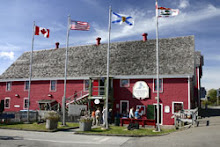
The flagship of the Fisheries Museum of the Atlantic is the retired fishing schooner Theresa E. Connor. Launched on 14 December 1938, from the Smith and Rhuland Shipyard in Lunenburg, Nova Scotia, the vessel fished until the mid-1960s. In 1967, as Lunenburg’s Centennial of Confederation project, Theresa E. Connor was unveiled as the Lunenburg Fisheries Museum.
The schooner is important because it is representative of thousands of two-masted fishing schooners that plied their trade all along the Atlantic coast of Canada and the United States. In turn, crew life aboard Theresa E. Connor also speaks of the lives of hundreds of thousands of fishermen.
As a saltbank schooner, Theresa E. Connor fished on the fishing banks near Newfoundland and Labrador, as well as those nearer Nova Scotia. The men fished from dories and brought their catch back to the mother schooner. The fish, mostly cod, were cleaned and then preserved in salt, in the hold of the vessel.
Theresa E. Connor was launched into a time that included steel trawlers. The last of the schooners fished virtually side-by-side with side trawlers that hauled their catch aboard their vessels with huge nets.
The fishing history of Theresa E. Connor ended on a bitter-sweet note. In May 1963, Captain Harry Oxner prepared the schooner for one final trip to the Banks. With a few Lunenburg-area fishermen, he set sail for Fortune Bay, Newfoundland, to get the remainder of his crew.
Unfortunately, the steady march of progress and technology made it impossible for him to get additional crew members for the last salt fishing trip. No one was willing to undertake the danger and hard work of dory fishing, when they had the chance to go on trawlers. Although the work was still hard and dangerous, they did not risk the danger of being lost in a dory.
The schooner spent the remainder of 1963 fishing with cod traps, in the Labrador fishery. Theresa E. Connor continued to fish, in a reduced capacity, for Zwicker and Company (Lunenburg) until 1966. The vessel was then sold to the Lunenburg Marine Museum Society.
Since then, hundreds of thousands of visitors have been welcomed aboard the schooner. The retired fishing captains who now work aboard the vessel share their experiences with people from around the world, keeping the memories alive for new generations.
Wishing you Smooth Sailing,
Heather
Subscribe to:
Posts (Atom)