Hello Everyone,
This morning, Lunenburg’s front harbour is like a pond of burnished silver, reflecting the colours of the sky, paused with an pregnant hush. Will it rain? Will it clear? We don’t know.
It is an easy thing to stand on land and look out to the ocean, wondering what the weather conditions might bring. It is an entirely different matter to be on the ocean, especially aboard a fishing vessel, and be at the mercy of the whims of nature.
Now-a-days, with computers and a multitude of ship-to-shore communications, sudden storms rarely arrive without some form of advance warning. Mariners no longer have to base their survival on the rhyming ditties of old, including:
Red sky in the morning,
Sailors take warning.
Red sky at night,
Sailor’s delight.
Sadly, the change in communication has taken place only within the span of a lifetime. The turning point for Nova Scotian schooners came with the August Gales of 1926 and 1927. Although the technology had been available before that date, fishing schooners were not equipped with receivers until after the horrific loss of life in the Gales.
Although the hurricanes hit along the shore and caused wide-spread destruction, the Lunenburg fleet was hit particularly hard. In those two years, 138 fishermen aboard six Lunenburg schooners were lost. One of the keenest felt aspects of the tragedy is that those on land knew of the approaching storms, based on weather reports. The men aboard the schooners had no such luxury and unwittingly faced a dark future.
After the 1927 Gale, the Province of Nova Scotia made arrangements to have weather signals sent via radio, from Cape Breton. The owners of the schooners were instructed to install radio receivers aboard their vessels. Those two simple acts, previously avoided because of the expense, undoubtedly saved countless lives.
Wishing you Smooth Sailing,
Heather
Monday, July 28, 2008


Monday, July 14, 2008
Set Sail for Lunenburg!
Hello Everyone,
One of the most wonderful aspects of a Museum is that it can be the focal point in the sharing of history between those who have roots in an area and those who visit. Although this sharing of history happens every day, special events make the exchange even more meaningful.
The Fisheries Museum of the Atlantic, in Lunenburg, Nova Scotia, is nearing its anniversary. Each year, on 23 July, we celebrate the history of the Atlantic fishery, especially as it pertains to the Canadian coast.
This year, on 23 July, we’re celebrating both the anniversary of the Museum and the 70th anniversary year of the schooner Theresa E. Connor. Theresa E. Connor is the flagship of the Museum and we are tremendously excited to be celebrating 70 years of her history!
Theresa E. Connor is the oldest saltbank schooner in Canada. In almost 30 years of fishing, the vessel never lost a crew member. During the course of her career, the vessel fished both fresh and salt fishing. This meant that sometimes the catch was preserved on ice (fresh) and sometimes it was preserved in salt (salt fishing).
If you’re planning to head our way on Wednesday 23 July, you’ll be highly entertained! Special events, musical entertainment and historical re-enactments are part of the celebrations. Theresa E. Connor will be open, free-of-charge to the public on that day! Retired fishermen and heritage interpreters will make the vessel come to life, with demonstrations and talks.
Wishing you Smooth Sailing,
Heather
One of the most wonderful aspects of a Museum is that it can be the focal point in the sharing of history between those who have roots in an area and those who visit. Although this sharing of history happens every day, special events make the exchange even more meaningful.
The Fisheries Museum of the Atlantic, in Lunenburg, Nova Scotia, is nearing its anniversary. Each year, on 23 July, we celebrate the history of the Atlantic fishery, especially as it pertains to the Canadian coast.
This year, on 23 July, we’re celebrating both the anniversary of the Museum and the 70th anniversary year of the schooner Theresa E. Connor. Theresa E. Connor is the flagship of the Museum and we are tremendously excited to be celebrating 70 years of her history!
Theresa E. Connor is the oldest saltbank schooner in Canada. In almost 30 years of fishing, the vessel never lost a crew member. During the course of her career, the vessel fished both fresh and salt fishing. This meant that sometimes the catch was preserved on ice (fresh) and sometimes it was preserved in salt (salt fishing).
If you’re planning to head our way on Wednesday 23 July, you’ll be highly entertained! Special events, musical entertainment and historical re-enactments are part of the celebrations. Theresa E. Connor will be open, free-of-charge to the public on that day! Retired fishermen and heritage interpreters will make the vessel come to life, with demonstrations and talks.
Wishing you Smooth Sailing,
Heather
Thursday, July 3, 2008
Memories - August Gales
Hello Everyone,
Every Nova Scotian coastal community owes some part of its history and prosperity to those who went fishing. Whether they worked from small inshore fishing boats or went to sea in schooners or trawlers, their life’s work meant prosperity for their villages and towns. The industry continues today and is just as important, although technology and the diminished fish stocks have changed the tenor of the activity.
Older fishermen often said, when pressed, that they did not like to talk to their families about the close calls that they had at sea. There was no point in worrying those at home and they were simply thankful to have survived.
Other stories became known, however, because of the extent of the tragedy that was involved. The fishermen did not live to come home; their loss made headlines, instead.
The August Gales that hit near Sable Island, in 1926 and 1927, took the lives of at least 138 Lunenburg-based fishermen. In total, six Lunenburg vessels were lost, with all hands. The tragedy did not confine itself to the Lunenburg area; devastation was felt all along the coastline.
In the August Gale of 1927, the last of the all-sail Gloucester schooners, Columbia, was lost at Sable Island. The crew of 22 were all from Nova Scotia, from the Queens County and Shelburne County areas.
One of the most poignant stories is that of Shelburne County crewman Allister Firth, who was just 17. He was lost with the rest of the crew, including his father, Arthur.
Young Allister did not want to go to sea that trip. He was a musician and wanted to play the violin. The family, however, was poor and the small wage that Allister could earn at sea was important. It became a source of great dispute between Allister and his father. On the day of sailing, the young lad hid in a closet in the home of a relative. His father found him, dragged him down the dock to the schooner, and threatened him that he had to go aboard Columbia and stay there. Arthur went and got their belongings and settled aboard the vessel.
Within weeks, the August Gale dealt crushing blows to the schooners caught in its grip. Columbia, with young Allister, was lost without a trace.
As a curious side-note, a few winters later, an American trawler was fishing in that area. It was night, but they were steaming along, when suddenly they caught hold of something heavy. The command was given to raise the trawl and, in the beam of light from the trawler, the crew was astounded to see the wreck of the schooner Columbia break the surface and pause for a few minutes. The lines then broke and the famous fishing and racing schooner dipped beneath the waves, for the last time.
The Fisheries Museum of the Atlantic, in Lunenburg, Nova Scotia, has a detailed exhibit about the August Gales of 1926 and 1927, with photographs of many of the men who were lost.
Wishing you Smooth Sailing,
Heather
Every Nova Scotian coastal community owes some part of its history and prosperity to those who went fishing. Whether they worked from small inshore fishing boats or went to sea in schooners or trawlers, their life’s work meant prosperity for their villages and towns. The industry continues today and is just as important, although technology and the diminished fish stocks have changed the tenor of the activity.
Older fishermen often said, when pressed, that they did not like to talk to their families about the close calls that they had at sea. There was no point in worrying those at home and they were simply thankful to have survived.
Other stories became known, however, because of the extent of the tragedy that was involved. The fishermen did not live to come home; their loss made headlines, instead.
The August Gales that hit near Sable Island, in 1926 and 1927, took the lives of at least 138 Lunenburg-based fishermen. In total, six Lunenburg vessels were lost, with all hands. The tragedy did not confine itself to the Lunenburg area; devastation was felt all along the coastline.
In the August Gale of 1927, the last of the all-sail Gloucester schooners, Columbia, was lost at Sable Island. The crew of 22 were all from Nova Scotia, from the Queens County and Shelburne County areas.
One of the most poignant stories is that of Shelburne County crewman Allister Firth, who was just 17. He was lost with the rest of the crew, including his father, Arthur.
Young Allister did not want to go to sea that trip. He was a musician and wanted to play the violin. The family, however, was poor and the small wage that Allister could earn at sea was important. It became a source of great dispute between Allister and his father. On the day of sailing, the young lad hid in a closet in the home of a relative. His father found him, dragged him down the dock to the schooner, and threatened him that he had to go aboard Columbia and stay there. Arthur went and got their belongings and settled aboard the vessel.
Within weeks, the August Gale dealt crushing blows to the schooners caught in its grip. Columbia, with young Allister, was lost without a trace.
As a curious side-note, a few winters later, an American trawler was fishing in that area. It was night, but they were steaming along, when suddenly they caught hold of something heavy. The command was given to raise the trawl and, in the beam of light from the trawler, the crew was astounded to see the wreck of the schooner Columbia break the surface and pause for a few minutes. The lines then broke and the famous fishing and racing schooner dipped beneath the waves, for the last time.
The Fisheries Museum of the Atlantic, in Lunenburg, Nova Scotia, has a detailed exhibit about the August Gales of 1926 and 1927, with photographs of many of the men who were lost.
Wishing you Smooth Sailing,
Heather
Monday, June 30, 2008
Blowing in the Wind
Hello Everyone,
As noted several times, the Fisheries Museum of the Atlantic is perched on the edge of Lunenburg’s front harbour.
Our front harbour has been witness to a great deal of history. The month of June always puts me in mind of Lunenburg’s first settlers. The Foreign Protestants who first populated our town came in two small waves of settlement, arriving on June 8 and June 17.
The weather played havoc with the plans and good intentions of the British military, who organized the settlement.
The initial flotilla of 14 transport ships that brought the first Lunenburgers to port, left Halifax at the end of May. The trip was expected to take only a day or two, but provisions for one week were packed, to ensure victuals for the voyage and the first few days in their new home.
Unfortunately, crew members eager to embark on their voyage put the provisions deep in the holds of the vessels, along with the settler’s baggage. Food and water were inaccessible. While the vessels waited out a period of "flat calm breeze" (i.e., no wind), word was sent to Halifax that fresh provisions were required. Settlers and crew waited a week before they were able to get a good sailing wind. Very early on the morning of June 7th, they left a cove near Halifax and ventured forth.
The early hours of June 8 saw the first Foreign Protestants grace the surface of Lunenburg’s front harbour. The second wave arrived on June 17, after a mere two days at sea.
From that point onward, the fine settlers put down roots and established a world-famous seaport - although most of the first generation Foreign Protestants were farmers!
Wishing you Smooth Sailing,
Heather
As noted several times, the Fisheries Museum of the Atlantic is perched on the edge of Lunenburg’s front harbour.
Our front harbour has been witness to a great deal of history. The month of June always puts me in mind of Lunenburg’s first settlers. The Foreign Protestants who first populated our town came in two small waves of settlement, arriving on June 8 and June 17.
The weather played havoc with the plans and good intentions of the British military, who organized the settlement.
The initial flotilla of 14 transport ships that brought the first Lunenburgers to port, left Halifax at the end of May. The trip was expected to take only a day or two, but provisions for one week were packed, to ensure victuals for the voyage and the first few days in their new home.
Unfortunately, crew members eager to embark on their voyage put the provisions deep in the holds of the vessels, along with the settler’s baggage. Food and water were inaccessible. While the vessels waited out a period of "flat calm breeze" (i.e., no wind), word was sent to Halifax that fresh provisions were required. Settlers and crew waited a week before they were able to get a good sailing wind. Very early on the morning of June 7th, they left a cove near Halifax and ventured forth.
The early hours of June 8 saw the first Foreign Protestants grace the surface of Lunenburg’s front harbour. The second wave arrived on June 17, after a mere two days at sea.
From that point onward, the fine settlers put down roots and established a world-famous seaport - although most of the first generation Foreign Protestants were farmers!
Wishing you Smooth Sailing,
Heather
Friday, June 20, 2008

Hello Everyone,
The Fisheries Museum of the Atlantic is heavily involved with the Toronto Nautical Festival, running this weekend (Friday, 20 June to Sunday). In addition to a fine display booth highlighting both the Museum and the town of Lunenburg, our boat builder is constructing a Lunenburg dory at the Festival.
The Province of Nova Scotia has also sent Lunenburg's fine ambassador, Bluenose II, to be the flagship of the event. The Province issued the following press release:
Nova Scotia's sailing ambassador, the world famous schoonerBluenose II, is sailing into Toronto, bringing with it the sights and sounds of Canada's seacoast province. The visit is part of the 2008 Nautical Festival at the Toronto Harbourfront Thursday, June 19 to Sunday, June 22. "We are thrilled to have Bluenose II at the Toronto Nautical Festival," said Bill Dooks, Minister of Tourism, Culture and Heritage. "While she was born in Nova Scotia, Bluenose II is a symbol of endurance and achievement for all Canadians and remains a wonderful ambassador for our province."
The event will feature a Nova Scotian pavilion, including a wide range of industry professionals demonstrating new products, sharing experiences and offering samples from Canada's seacoast province. It will also give the public an opportunity to stroll the deck of Bluenose II.
Popular entertainers, such as the Barra MacNeils, will perform at the festival, immersing Toronto residents in Nova Scotia's rich and lively music. Information about Nova Scotia as a travel destination will be featured at the Nautical Festival. Included will be an outline of air travel options available to those interested in visiting Nova Scotia from Toronto's Pearson International and City Centre airports.
The original Bluenose was launched from a shipyard in Lunenburg on March 26, 1921. Because of wins in the races of Grand Banks schooners between Canada and the U.S., the Bluenose became known as Queen of the North Atlantic. In 1963, the ship's replica, Bluenose II, was launched from the same shipyard, also built by many of the same men who worked on the original Bluenose.
=====
If you're in Toronto this weekend, drop in an visit with our staff from the Fisheries Museum of the Atlantic!
Wishing you Smooth Sailing,
Heather
Thursday, June 19, 2008
Looks can be Deceiving

Hello Everyone,
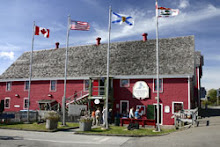
Brightly painted red buildings on the waterfront in Lunenburg, Nova Scotia are eye-catching, gorgeous and almost a dime-a-dozen. The Fisheries Museum of the Atlantic stands out from the crowd, with a large parking lot and attractive flags at the entrance, but for those who approach by land and not sea, looks can be deceiving.
Many first-time visitors to the Museum have no idea how large the site is, with several inter-connected buildings, an authentic fishing schooner, a retired fishing trawler (both open to the public), a theatre, exhibits and an aquarium.
The boat shop, at the far end of the property, is often a hive of activity. The boat builder constructs dories, as well as special projects of various types of small boats.
The Whaling and Whales exhibit is tremendously popular, especially with school groups. A traditional, albeit Norwegian, whale arch frames the entrance. The arch is composed of the jaw bones of a fin whale. Laughter and excitement bubble to the fore, when students measure out the length of fin and blue whales, on the wharf.
Described as friendly and fascinating, the Fisheries Museum of the Atlantic has many exhibits and activities for visitors. Rather than being "too small", the Museum offers delights that have enraptured visitors for many hours, as well as days!
Wishing you Smooth Sailing,
Heather
Wednesday, June 18, 2008
Ride the Lobster!
Hello Everyone,
The Fisheries Museum of the Atlantic is open for the summer season, with more activities and delights than you would ordinarily imagine.
One of the special events that came our way is the Ride the Lobster ( www.ridethelobster.com ) unicycle race! It is an international race, with 36 teams racing 800 km along the length of Nova Scotia (apparently we’re the crustacean-shaped province).
The cyclists came rushing through Lunenburg, yesterday, and the Fisheries Museum of the Atlantic was one of the official check-in stations. It was simply amazing to see the riders balanced atop large unicycles, cycling at speeds of upwards of 25 km per hour. On the open highway, the more experienced racers are able to go even faster.
One of the special treats that we had on-site for the afternoon was a trio from the Lunenburg County Fiddlers. They blended into the festive spirit of the day, with their lively Down East music. One of the unicycle team members, a fellow from British Columbia, was ecstatic with the chance to listen and to perform with the group. A trained violinist, he has been picking up various forms of violin (or fiddle) music - and his dulcet tones and remarkable ability enriched the musical experience for everyone.
Ride the Lobster continues through the rest of the week, moving into Cape Breton for the grand finale.
Wishing you Smooth Sailing,
Heather
The Fisheries Museum of the Atlantic is open for the summer season, with more activities and delights than you would ordinarily imagine.
One of the special events that came our way is the Ride the Lobster ( www.ridethelobster.com ) unicycle race! It is an international race, with 36 teams racing 800 km along the length of Nova Scotia (apparently we’re the crustacean-shaped province).
The cyclists came rushing through Lunenburg, yesterday, and the Fisheries Museum of the Atlantic was one of the official check-in stations. It was simply amazing to see the riders balanced atop large unicycles, cycling at speeds of upwards of 25 km per hour. On the open highway, the more experienced racers are able to go even faster.
One of the special treats that we had on-site for the afternoon was a trio from the Lunenburg County Fiddlers. They blended into the festive spirit of the day, with their lively Down East music. One of the unicycle team members, a fellow from British Columbia, was ecstatic with the chance to listen and to perform with the group. A trained violinist, he has been picking up various forms of violin (or fiddle) music - and his dulcet tones and remarkable ability enriched the musical experience for everyone.
Ride the Lobster continues through the rest of the week, moving into Cape Breton for the grand finale.
Wishing you Smooth Sailing,
Heather
Subscribe to:
Posts (Atom)